A Practical Solution for Ducted Ventilation
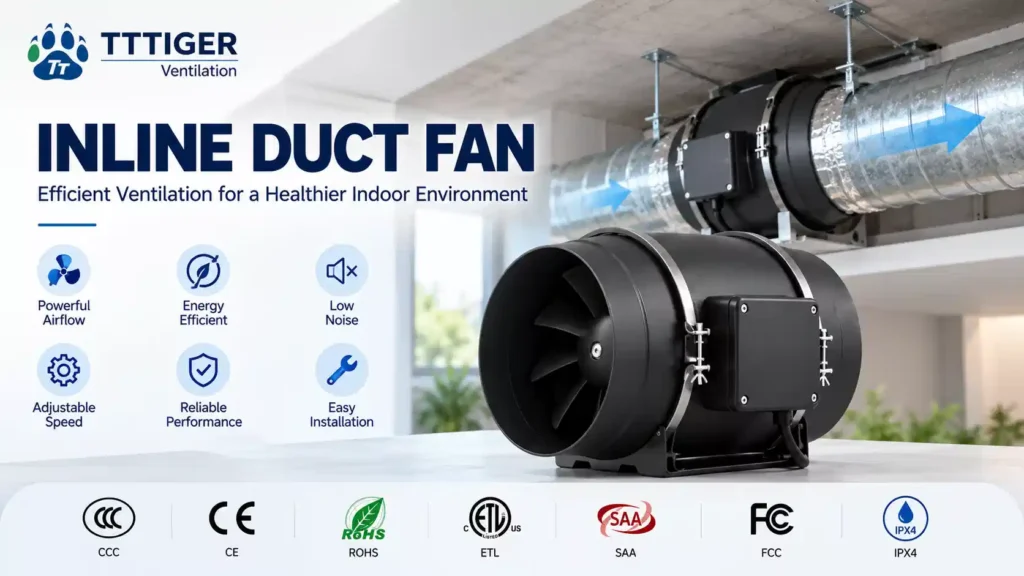
An inline duct fan is designed to move air through a connected duct system. Unlike a conventional wall-mounted exhaust fan, it can be positioned along the duct route, allowing greater flexibility when planning a ventilation installation.
These fans are used in residential, commercial, and light industrial environments where controlled air movement is required.
Choosing the right inline duct fan involves more than duct diameter. Motor technology, airflow performance, system resistance, speed control, and product documentation all deserve consideration.
Key Features of an Inline Duct Fan
EC Motor Technology
Many modern inline duct fans use electronically commutated (EC) motors.
EC motor technology allows electronic speed control and can offer efficient operation across suitable working conditions.
Actual efficiency and electricity consumption depend on the specific motor, fan design, and operating point.
Adjustable Speed Control
Some inline duct fans are equipped with a compatible external speed controller.
This allows users to adjust fan speed to suit different ventilation requirements, rather than operating at a single fixed speed.
It is important to check the controller type and operating range specified for each model.
Compact Duct Installation
The cylindrical housing of an inline duct fan is designed to connect with compatible round ductwork.
Fans can be installed in suitable ceiling voids, technical spaces, or other accessible locations along the duct route.
Proper mounting, duct support, electrical installation, and maintenance access are important for reliable operation.
Where Are Inline Duct Fans Used?
Inline duct fans can be incorporated into different ventilation arrangements.
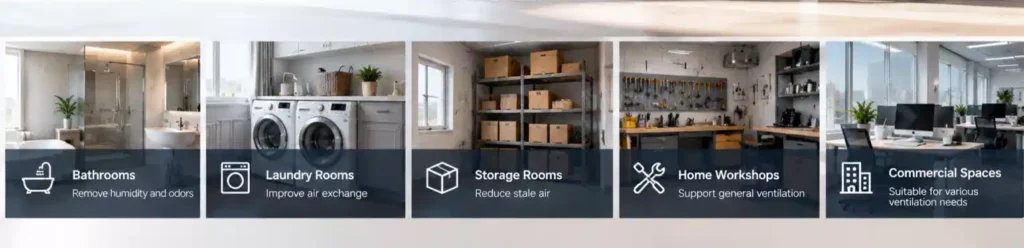
Residential Ventilation: Used in suitable bathroom, utility room, and general household exhaust systems to help remove humid or stale air.
Commercial Spaces: Support ducted air movement in offices, retail premises, and other buildings requiring localized ventilation.
Storage Areas: Help provide air exchange in enclosed storage rooms where natural airflow is limited.
General Workshop Ventilation: Can support ordinary air exchange where the air does not contain hazardous or combustible contaminants requiring specialized extraction equipment.
The fan should always be selected according to the application, duct system, and actual operating conditions.
Understanding Inline Duct Fan Specifications
Consider the TTTIGER DF200-A as an example of an EC inline duct fan.
| Specification | DF200-A |
|---|---|
| Duct Diameter | 200 mm (8 inch nominal) |
| Motor | EC |
| Voltage / Frequency | 100–240 V, 50/60 Hz |
| Rated Power | 70 W |
| Speed | 2000 RPM |
| Airflow | 553 CFM |
| Static Pressure | 320 Pa |
| Noise | 32 dBA |
These values are provided as product specifications. The stated airflow, pressure, and noise figures should not be interpreted as performance at the same operating point unless confirmed by the manufacturer’s test data.
For actual installation, airflow depends on the fan’s performance curve and the resistance of the connected ductwork.
Certifications and Compliance Information
For international buyers, product compliance documentation is an important part of supplier evaluation.
The TTTIGER inline duct fan range has been described as having CCC, CE, RoHS, ETL, SAA, FCC, and IPX4-related documentation or markings.
These designations address different aspects of product compliance:
- CCC: China’s compulsory certification scheme for products within its applicable scope.
- CE: A European conformity marking used for products subject to applicable EU requirements.
- RoHS: Restrictions on specified hazardous substances in electrical and electronic equipment.
- ETL: A third-party product certification mark associated with applicable safety standards.
- SAA: Commonly used to refer to Australian electrical product certification arrangements.
- FCC: U.S. requirements relating to radio-frequency emissions or electromagnetic interference, where applicable.
- IPX4: An enclosure water-ingress protection rating indicating resistance to splashing water under defined test conditions.
These are not interchangeable certifications. Their applicability depends on the product model, configuration, market, and relevant technical standards.
Buyers should request the corresponding certificates, declarations, and test reports for the exact model being purchased.
Choosing the Right Inline Duct Fan
Before selecting a fan, consider the duct diameter, required airflow, pressure losses, available electrical supply, and installation environment.
A larger fan is not automatically the better choice. A properly matched fan and duct system will generally provide more predictable performance.
If speed control or a particular compliance document is required, confirm availability for the selected model before ordering.
Reliable Ventilation Starts With the Right Selection
Inline duct fans offer a practical way to move air through residential and commercial duct systems.
Understanding motor technology, airflow requirements, installation conditions, and compliance documentation helps buyers compare products more effectively.
For the best results, select the fan according to the complete ventilation system rather than relying on a single specification.