When people think of ventilation fans, they often picture a bathroom exhaust fan or a large industrial ventilation system.
However, inline duct fans can also be used in everyday spaces where air needs to move through ductwork.
Unlike a conventional wall-mounted fan, an inline duct fan is installed within a ventilation duct. It can be positioned away from the room, making it useful where direct fan installation is inconvenient.
Here are five common applications worth considering.
1. Bathrooms – Removing Humid Air
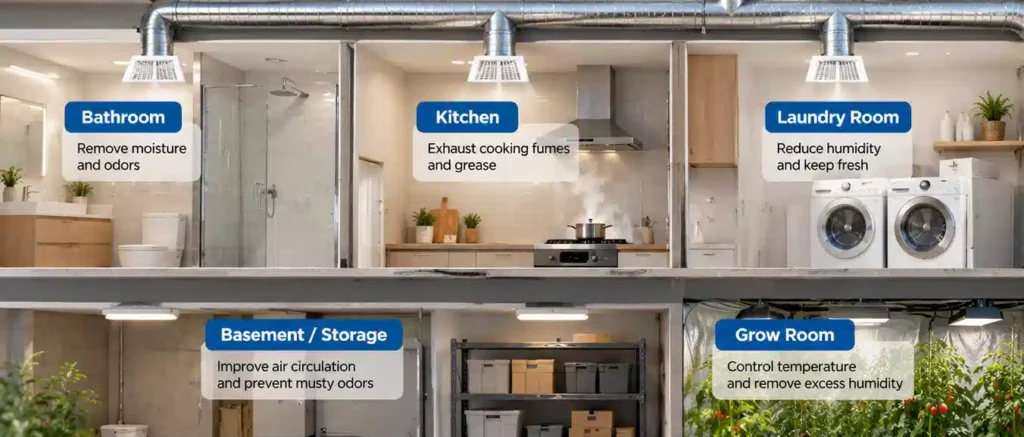
Bathrooms are among the most practical places for ducted exhaust ventilation.
Hot showers release moisture into the air. Without adequate ventilation, humidity can accumulate on mirrors, walls, and ceilings.
An inline duct fan can connect a bathroom exhaust grille to an outdoor outlet, helping remove moisture-laden air.
This arrangement is especially useful where the fan needs to be installed remotely, away from the bathroom ceiling grille.
Main purpose: Removing humid air and bathroom odors.
2. Laundry Rooms – Managing Moisture and Stale Air
Laundry rooms can become warm and humid, especially when washing and drying clothes in enclosed spaces.
Where suitable ductwork is available, an inline exhaust fan can help move humid indoor air outdoors.
This may make a laundry room more comfortable and help limit moisture buildup.
Main purpose: Supporting air exchange and humidity control.
Important: An ordinary inline duct fan is not a substitute for a clothes dryer’s dedicated exhaust system.
3. Basements – Improving Air Exchange
Some basements have limited windows and insufficient natural ventilation.
Depending on the building design, an inline duct fan may form part of a mechanical ventilation system that removes stale air or supplies outdoor air through dedicated ductwork.
However, moisture problems caused by water leaks or groundwater infiltration require separate solutions.
Main purpose: Improving ventilation in enclosed or poorly ventilated basement spaces.
4. Storage Rooms and Walk-In Closets – Reducing Stagnant Air
Enclosed storage rooms and large walk-in closets may have limited air circulation, particularly when doors remain closed for long periods.
A properly designed duct ventilation system can help exchange air in these spaces.
For example, a small exhaust grille can be connected to a remotely installed inline fan, provided there is an appropriate replacement-air path.
Main purpose: Reducing stagnant air and supporting ventilation in enclosed spaces.
5. Home Workshops – Removing Stale Air
Small home workshops and hobby rooms may benefit from additional ventilation during ordinary activities.
An inline duct fan can be incorporated into a general ventilation system to help exhaust stale indoor air.
However, activities involving hazardous fumes, combustible dust, welding, or flammable vapors require specifically designed extraction equipment. An ordinary inline fan should not be assumed suitable for these applications.
Main purpose: General air exchange in suitable home workspaces.
What Should You Check Before Installing an Inline Duct Fan?
The right fan depends on more than the size of the room.
Consider the following:
- Airflow requirements: Determine how much ventilation the space needs.
- Duct diameter: Match the fan to compatible ductwork.
- Duct length and bends: Longer or more restrictive ducts may require greater fan pressure capability.
- Installation location: Allow safe mounting and convenient maintenance access.
- Outdoor termination: Exhaust air should discharge outdoors through an appropriate outlet.
- Replacement air: Exhaust ventilation needs a suitable path for incoming air.
Always check the manufacturer’s specifications and applicable building requirements before installation.
Finding the Right Fan for Your Space
Inline duct fans provide a flexible ventilation option for bathrooms, laundry rooms, basements, enclosed storage spaces, and suitable home workshops.
The key is to choose a fan that matches the ventilation task rather than relying on fan size alone.
Whether the goal is to remove humid air, reduce stale air, or improve air exchange, a properly designed duct ventilation system can make everyday indoor spaces more comfortable.