What Is an Air Curtain?
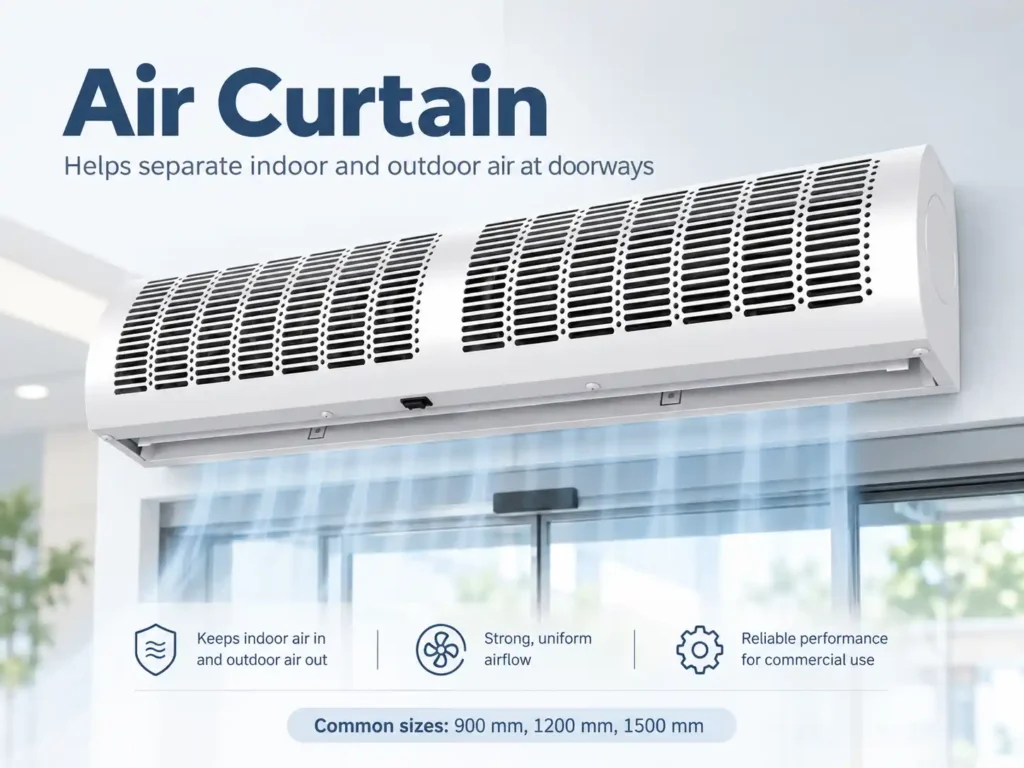
An air curtain is an electrically powered device installed above a doorway to create a continuous downward stream of air.
This airflow forms an invisible barrier that helps separate indoor and outdoor environments without blocking access.
Air curtains are widely used in supermarkets, shopping malls, restaurants, hotels, and commercial buildings where doors frequently open and close.
Unlike traditional exhaust fans, which primarily move air from one area to another, an air curtain is designed to create an airflow barrier across an opening.
How Does an Air Curtain Work?
An air curtain draws surrounding air into the unit through an intake grille. An internal fan then accelerates the air and directs it through a narrow outlet along the bottom of the housing.
The resulting downward airflow forms an air barrier across the doorway.
When properly selected and installed, this air barrier can help reduce unwanted air exchange between indoor and outdoor environments.
It may also limit the entry of some airborne dust, outdoor odors, and flying insects.
However, an air curtain does not create a completely airtight seal. Its effectiveness depends on airflow velocity, doorway dimensions, installation height, and environmental conditions.
Key Benefits of Installing an Air Curtain
Reduced Indoor and Outdoor Air Exchange
Air curtains help limit unwanted air movement through frequently opened entrances.
This can support indoor temperature stability and may reduce heating or cooling losses in suitable applications.
Dust and Insect Control
The concentrated airflow acts as a physical air barrier that may discourage airborne dust and flying insects from entering.
Performance depends on the application and correct installation.
Convenient Access
Unlike physical barriers, air curtains allow customers, employees, and equipment to pass through doorways without obstruction.
This makes them practical for busy commercial entrances.
Comfortable Indoor Conditions
By reducing unwanted drafts and air exchange, air curtains can contribute to a more comfortable indoor environment.
FM-125 Series Air Curtain: Common Sizes
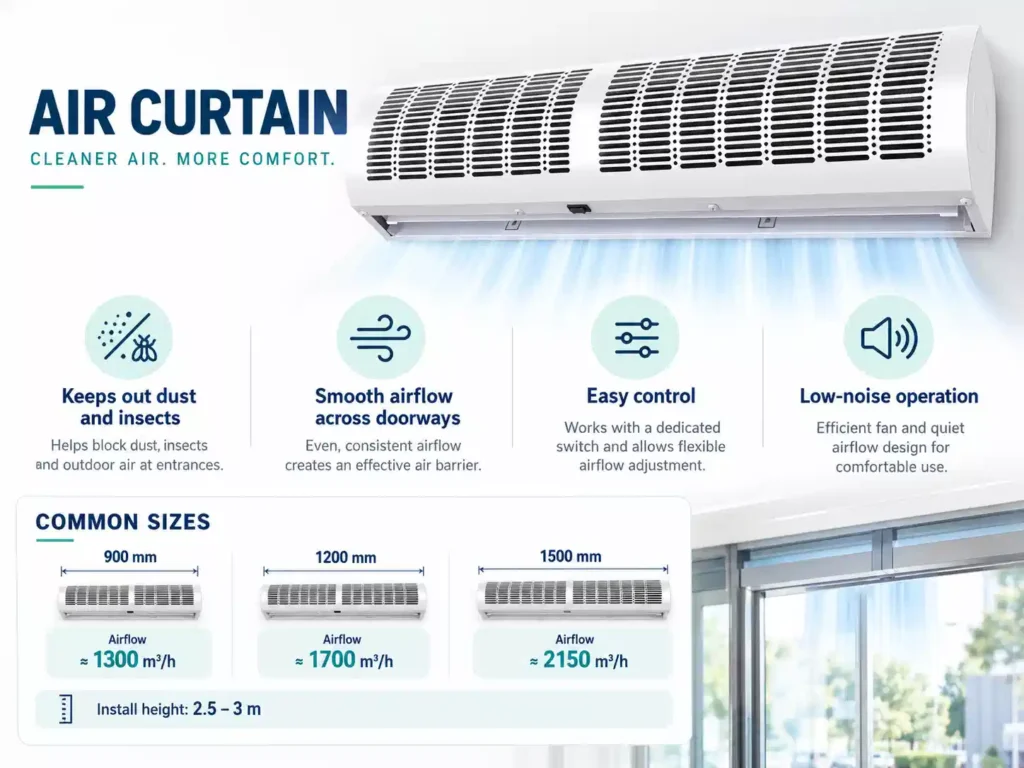
Our FM-125 series is designed for commercial entrance applications and offers multiple length options.
The following are three commonly selected models.
| Model | FM-125-09 | FM-125-12 | FM-125-15 |
|---|---|---|---|
| Length | 900 mm | 1200 mm | 1500 mm |
| Voltage | 220 V | 220 V | 220 V |
| Frequency | 50 Hz | 50 Hz | 50 Hz |
| Power | 105 W | 160 W | 200 W |
| Airflow | 1300 m³/h | 1700 m³/h | 2150 m³/h |
| Air Velocity | 9–11 m/s | 9–11 m/s | 9–11 m/s |
| Noise | 57 dB | 58 dB | 59 dB |
The manufacturer specifies an installation height of approximately 2.5–3 meters for this series.
Different doorway widths and site conditions may require different unit lengths or configurations.
The specifications above are manufacturer-provided values; actual operating performance depends on installation and operating conditions.
Common Applications of Air Curtains
Air curtains are used in a wide range of commercial environments.

Supermarkets and Retail Stores: Help manage unwanted air movement at entrances with frequent customer traffic.
Restaurants and Cafés: Provide an airflow barrier that may help reduce drafts, dust intrusion, and flying insect entry.
Hotels and Shopping Malls: Support convenient access while helping separate indoor and outdoor air.
Office Buildings: Help maintain comfortable conditions around frequently used entrances.
Commercial Facilities: Offer a practical airflow barrier for suitable entrance and doorway applications.
What to Consider Before Installation
Choosing the correct air curtain involves more than matching the product length to the doorway.
Several factors should be considered:
- Door Width: Select an appropriate unit length to provide sufficient coverage.
- Installation Height: Verify that the model is suitable for the mounting height.
- Airflow Performance: Consider the required air velocity and airflow coverage.
- Noise Level: Choose a model suitable for the surrounding environment.
- Electrical Requirements: Confirm that the available power supply matches the product specifications.
Proper positioning is especially important. The discharged air should be directed across the doorway according to the manufacturer’s installation instructions.
Choosing the Right Air Curtain for Your Entrance
A well-selected air curtain can help improve comfort and reduce unwanted air exchange in busy commercial environments.
For smaller entrances, a compact unit may provide appropriate coverage, while wider doorways may require a longer unit or multiple units.
The FM-125 series provides several size options for different commercial applications.
Before selecting a model, consider the doorway dimensions, installation height, airflow requirements, and site conditions to ensure the air curtain is suitable for your ventilation needs.