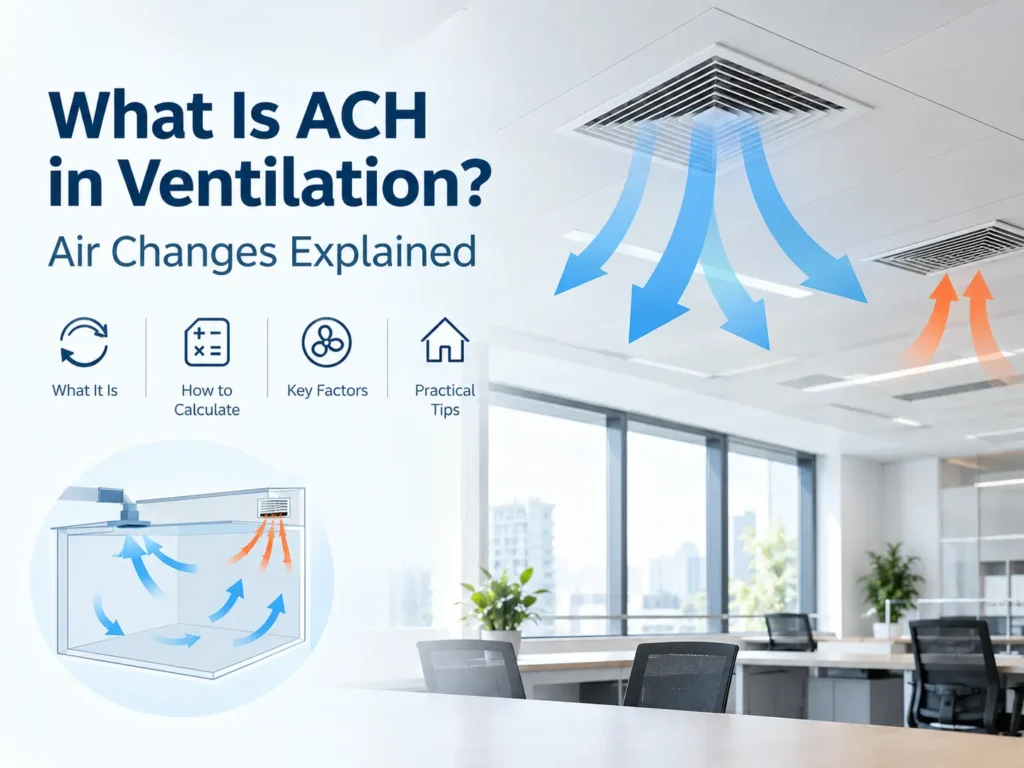
Ventilation plays an important role in maintaining indoor air quality, controlling humidity, and removing unwanted airborne contaminants. When evaluating a ventilation system, one measurement that frequently appears in technical discussions is air changes per hour, commonly abbreviated as ACH.
But what does ACH actually mean, how is it calculated, and why does it matter when selecting a ventilation fan?
Understanding this measurement can help homeowners, contractors, and facility managers make more informed decisions about ventilation equipment and system design.
1. What Does Air Changes per Hour Mean?
Air changes per hour (ACH) describes how many times the equivalent volume of air supplied to or removed from a space passes through that space in one hour.
For example, a room with an ACH value of 3 has a ventilation airflow equivalent to three times the room’s volume per hour.
However, ACH does not mean that every air molecule in the room is replaced three times. Indoor air mixes with incoming air, so some air may remain while other air is removed.
ACH is commonly used when discussing ventilation in homes, offices, workshops, warehouses, and other indoor environments.
2. How Do You Calculate ACH?
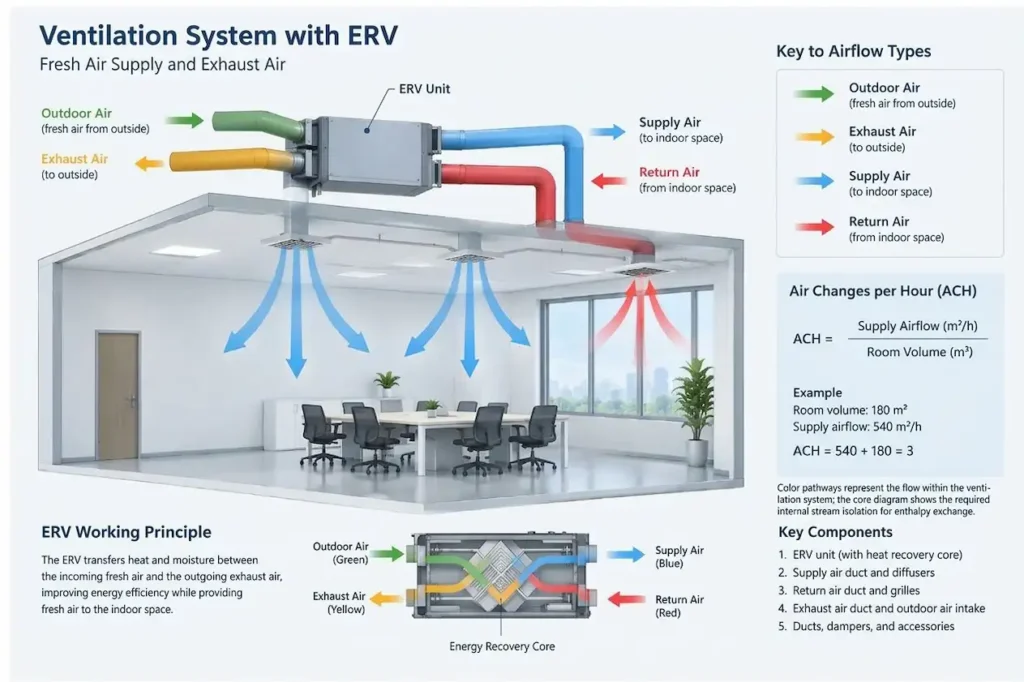
The basic ACH formula is:
ACH = Airflow per Hour ÷ Room Volume
When airflow is measured in cubic feet per minute (CFM) and room volume is measured in cubic feet, the formula becomes:
ACH = (CFM × 60) ÷ Room Volume
For metric measurements:
ACH = Airflow (m³/h) ÷ Room Volume (m³)
Let’s consider an example.
A room measures 10 meters long, 6 meters wide, and 3 meters high.
Room volume:
10 × 6 × 3 = 180 m³
If the ventilation system supplies an airflow of 540 m³/h, the calculated ACH is:
540 ÷ 180 = 3 ACH
This means the airflow is equivalent to three times the room volume per hour.
The calculation is straightforward, but the result is only as reliable as the airflow value used. A fan’s actual airflow may differ from its advertised free-airflow rating because of duct resistance, filters, grilles, and other system components.
3. What Factors Affect ACH?
Several factors determine the ACH achieved by a ventilation system.
Room Size
Larger rooms require greater airflow to achieve the same ACH, assuming the room conditions and ventilation objectives are comparable.
A fan that provides adequate ventilation in a small room may not deliver the same air-change rate in a much larger space.
Fan Airflow Capacity
The fan’s delivered airflow directly affects ACH. Higher airflow generally produces a higher calculated air-change rate when room volume remains constant.
However, choosing a fan based on its maximum airflow rating alone can be misleading. The operating conditions and resistance of the installed system must also be considered.
Ductwork and System Resistance
Long ducts, restrictive fittings, filters, dampers, and grilles can reduce the airflow delivered by a fan.
Proper duct sizing and suitable equipment selection help the system achieve its intended ventilation performance.
Air Distribution
ACH describes an overall airflow rate, but it does not fully explain how air moves throughout a room.
Poorly positioned supply and exhaust openings can create stagnant areas or allow incoming air to travel directly to an exhaust outlet without effectively mixing throughout the space.
Fan placement and air distribution therefore matter alongside the calculated ACH.
4. Is a Higher ACH Always Better?
Not necessarily.
Higher air-change rates may be appropriate when a space requires more ventilation to remove heat, odors, moisture, or airborne contaminants. However, increasing airflow can also increase energy consumption and may create drafts or additional noise.
In mechanically cooled or heated buildings, excessive outdoor air can increase the load on heating and cooling equipment.
The appropriate ventilation rate depends on the building type, occupancy, activities, contaminant sources, applicable codes, and the purpose of the ventilation system.
For this reason, there is no single ACH value that is suitable for every room or application.
Where ventilation standards specify airflow per person, contaminant-control requirements, or other design criteria, those requirements should take precedence over using a generic ACH target alone.
5. How Does ACH Help You Choose a Ventilation Fan?
ACH can provide a useful starting point when estimating the airflow needed for a room.
First, determine the room’s volume. Next, establish the required ventilation rate based on the intended application and applicable requirements. The corresponding airflow can then be calculated.
For example, if a room has a volume of 180 m³ and a project specifies a target of 4 ACH, the corresponding airflow is:
180 × 4 = 720 m³/h
This is the theoretical airflow required to meet that target.
The next step is to select a fan capable of delivering the required airflow under the actual system operating conditions. For ducted installations, this means considering static pressure as well as airflow.
It is also important to account for the location of air inlets and outlets, the type of air being exhausted, and any requirements for replacement air.
A properly selected ventilation fan should meet the project’s airflow requirements without relying solely on its maximum rated capacity.
6. ACH vs. Airflow: What Is the Difference?
ACH and airflow are related, but they describe different things.
Airflow measures the volume of air moving through a ventilation system over a period of time. Common units include CFM and m³/h.
ACH expresses that airflow relative to the volume of the room, using changes per hour as the unit.
For example, an airflow of 600 m³/h may provide 3 ACH in a 200 m³ room but only 1.5 ACH in a 400 m³ room.
This is why airflow ratings should always be considered alongside the size and ventilation requirements of the space.
Conclusion
Air changes per hour is a useful way to relate ventilation airflow to room volume. By understanding the ACH formula, building operators and equipment buyers can estimate airflow requirements and compare ventilation scenarios more effectively.
However, ACH alone does not guarantee good indoor air quality. Actual fan performance, air distribution, contaminant sources, and application-specific ventilation requirements must also be considered.
When selecting a ventilation fan, use ACH as one part of the overall assessment, then verify that the selected equipment can deliver the required airflow under real operating conditions.