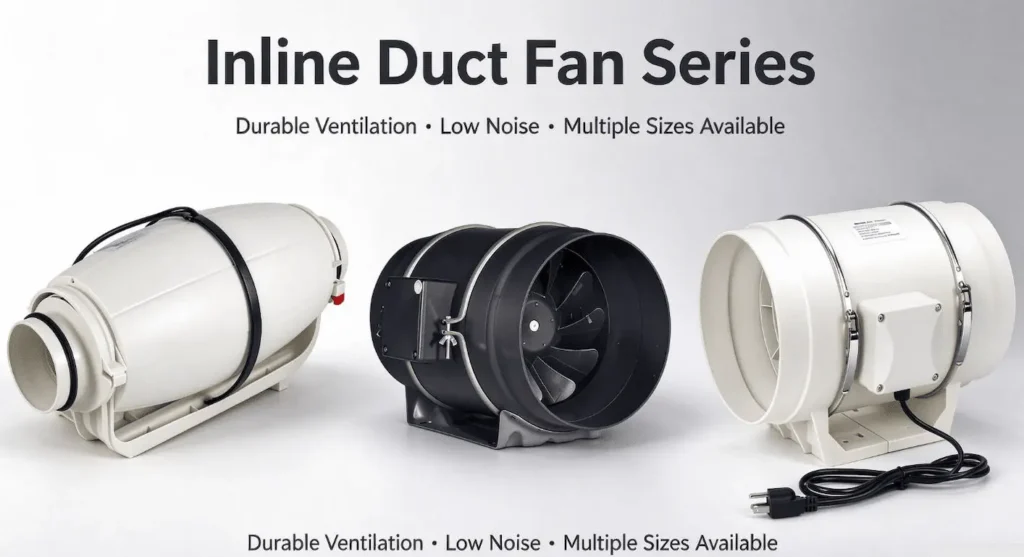
A ventilation fan may be rated for a certain airflow, but the actual airflow in a building can be much lower than expected.
This does not necessarily mean the fan is faulty.
In most ventilation systems, airflow depends on the fan, ductwork, filters, grilles, dampers, and overall system resistance. If one part of the system creates too much resistance, the actual airflow can drop.
So, what causes low airflow in a ventilation system, and how can you troubleshoot it?
1. The Fan Is Not Properly Sized
The first thing to check is whether the fan is suitable for the application.
A fan’s rated airflow is normally measured under specific test conditions. Once the fan is connected to a real ventilation system, the airflow can change because the system creates resistance.
A fan that looks powerful on paper may not provide enough airflow if the application requires high static pressure.
When selecting a fan, consider both:
- Required airflow
- Required static pressure
The fan should be selected based on the actual operating conditions rather than maximum airflow alone.
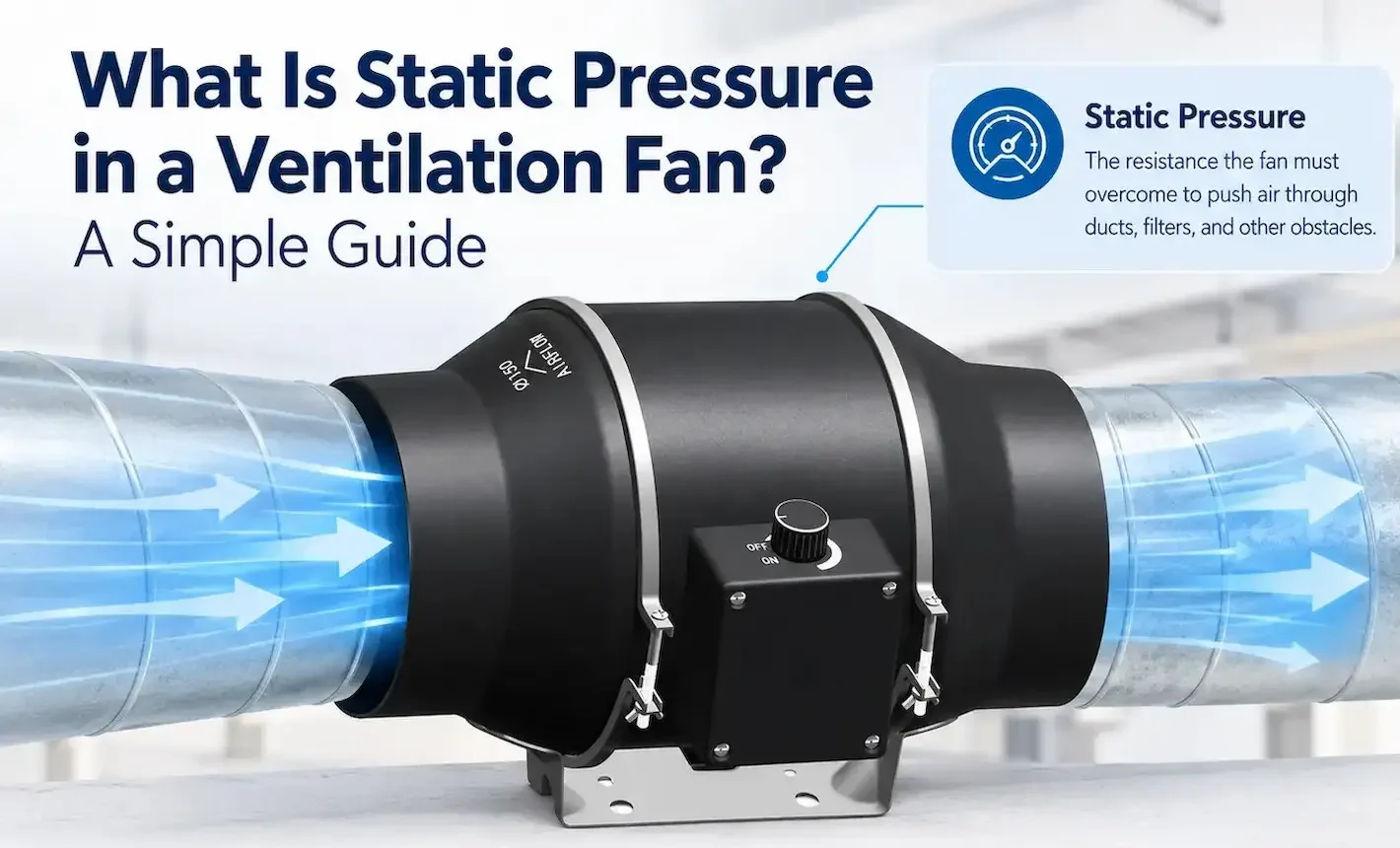
2. High Static Pressure
Static pressure is one of the most common reasons for reduced airflow.
Every component in a ventilation system creates some resistance. This includes:
- Long ducts
- Duct bends
- Filters
- Grilles
- Dampers
- Louvers
- Exhaust outlets
As system resistance increases, the fan has to work against a higher pressure, and the available airflow decreases.
This is why a fan’s performance curve is important when designing a ducted ventilation system.
3. The Duct Is Too Long or Too Small
Duct design has a direct impact on airflow.
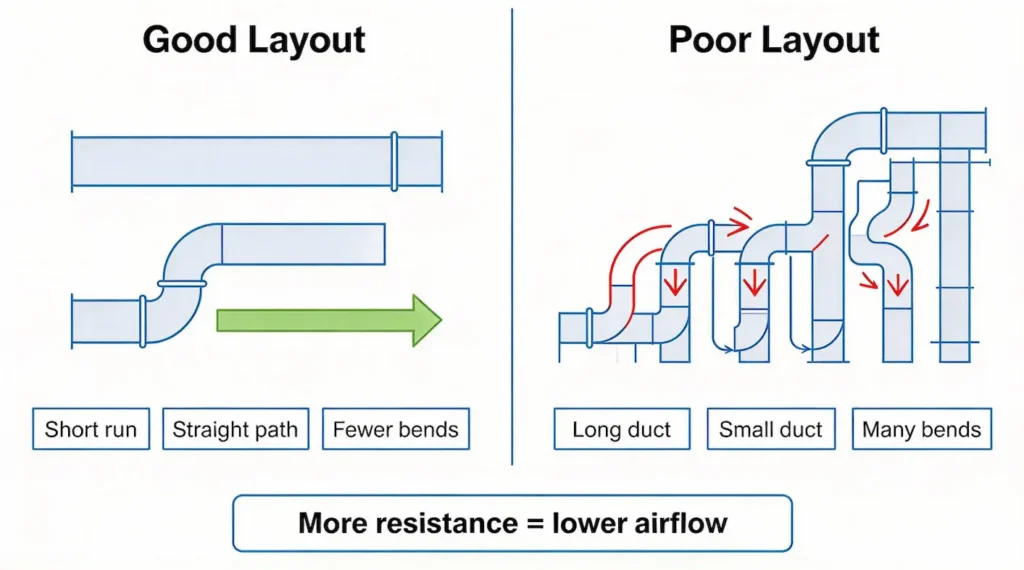
A long duct creates more resistance than a short duct. A duct that is too small for the required airflow can also increase resistance.
For better ventilation performance:
- Choose an appropriate duct diameter
- Keep duct runs as short as practical
- Avoid unnecessary bends
- Use smooth and properly connected ductwork
If a system has a long duct run, simply choosing a fan with a higher maximum CFM may not solve the problem. The fan must also have sufficient pressure capability.
4. Too Many Bends and Restrictions
Not all duct systems are straight.
Elbows, transitions, branches, dampers, filters, and other components change the way air moves through the system.
A system with several sharp bends can have considerably more resistance than a simple straight duct.
When possible, use gradual changes in direction and avoid unnecessary restrictions near the fan inlet and outlet.
5. Dirty Filters or Grilles
Filters are designed to remove dust and particles from the air, but they also create resistance.
When a filter becomes dirty, the resistance can increase and airflow may decrease.
The same applies to intake grilles, exhaust grilles, and other air passages.
If airflow has gradually become weaker over time, check and clean the filter and grille before assuming that the fan itself has a problem.
6. Air Leakage in the Duct System
A ventilation fan can move air correctly while the system still performs poorly because of leakage.
Loose connections, damaged flexible ducts, poorly sealed joints, and gaps around openings can allow air to escape.
Check the complete duct system, especially:
- Fan-to-duct connections
- Flexible duct joints
- Duct seams
- Branch connections
- Wall or ceiling penetrations
A properly sealed duct system helps deliver more of the fan’s airflow to the intended location.
7. Incorrect Fan Installation
Installation problems can also reduce airflow.
For example, an inline fan installed in the wrong airflow direction will not operate as intended. Restrictions placed too close to the fan inlet or outlet can also affect airflow conditions.
During installation, check:
Airflow direction → Duct connection → Duct size → Exhaust outlet
The fan should also have enough clearance around its inlet and outlet according to the manufacturer’s installation requirements.
8. The Fan Speed Is Too Low
Some ventilation systems use speed controllers or variable-speed motors.
If the fan is operating below its intended speed, airflow will naturally be lower.
If airflow suddenly drops, check whether:
- The fan speed has been changed
- The controller is working correctly
- The power supply is stable
- The motor is operating normally
For systems with variable-speed control, the fan should be operated within the manufacturer’s specified control range.
How to Troubleshoot Low Airflow
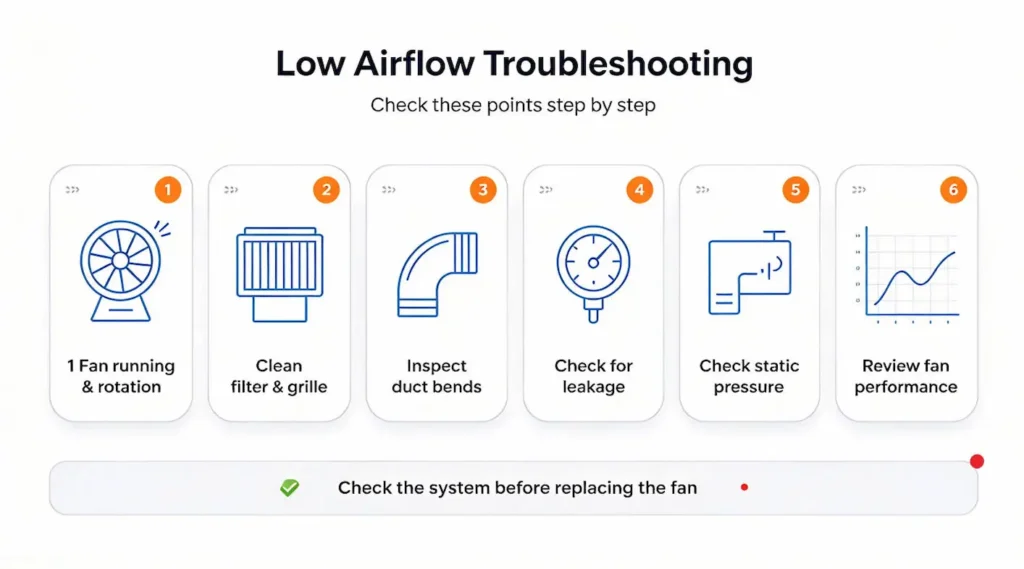
Instead of replacing the fan immediately, check the system step by step.
Step 1: Check the Fan
Make sure the fan is running, rotating in the correct direction, and operating at the expected speed.
Step 2: Check the Filter and Grille
Remove dust, dirt, and other blockages from air passages.
Step 3: Inspect the Ductwork
Look for crushed ducts, blockages, excessive bends, or an undersized duct.
Step 4: Check for Air Leaks
Inspect duct joints and connections for gaps or loose sections.
Step 5: Consider Static Pressure
Estimate or measure the resistance of the complete ventilation system.
Step 6: Check the Fan Performance Curve
Compare the required airflow with the fan’s performance at the expected static pressure.
This final step is particularly important for ducted ventilation systems.
How to Prevent Low Airflow
Good ventilation performance starts with system design.
Before installation, determine the required airflow and consider the complete air path from the intake to the exhaust outlet.
A practical checklist includes:
Correct fan → Correct duct size → Efficient duct layout → Clean filters → Sealed connections → Suitable static pressure
Regular maintenance is also important. Filters, grilles, ducts, and exhaust outlets should be inspected periodically, especially in dusty or high-humidity environments.
Conclusion
Low airflow in a ventilation system can have many causes. The problem may come from the fan, but it can also result from high static pressure, undersized ducts, excessive bends, dirty filters, air leakage, incorrect installation, or low fan speed.
The key is to look at the ventilation system as a whole rather than judging the fan by its maximum airflow rating alone.
For ducted ventilation applications, understanding the relationship between airflow and static pressure is especially important. A properly selected fan combined with well-designed ductwork can help the system deliver the airflow it was designed to provide.