An air curtain can be a practical addition to a busy commercial entrance. By creating a continuous stream of air across an open doorway, it helps reduce unwanted air exchange between indoor and outdoor spaces.
However, installing an air curtain above a door doesn’t automatically guarantee good performance. Its effectiveness depends on several factors, including mounting height, unit width, airflow direction and surrounding conditions.
Here’s what to consider before choosing and installing one.
How Does an Air Curtain Work?
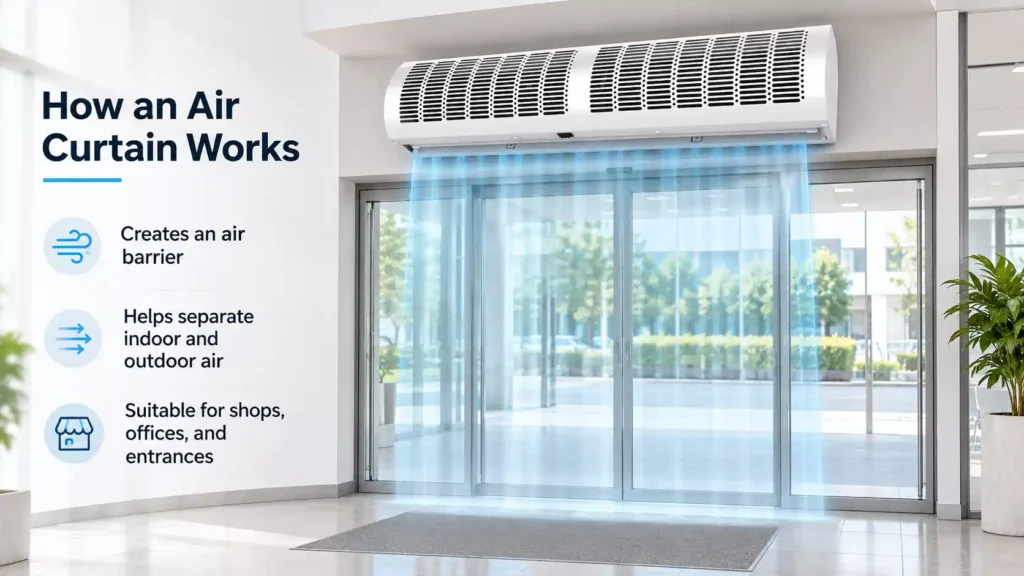
An air curtain draws air into the unit and discharges it through a long, narrow outlet, producing a concentrated stream of air.
When installed horizontally above a doorway, the airflow travels downward across the opening, creating an invisible air barrier.
This barrier helps limit the movement of outdoor air, dust and flying insects through an open entrance. It can also help reduce unwanted heat transfer between areas with different temperatures.
Unlike an exhaust fan, an air curtain is not primarily designed to replace indoor air with outdoor air. Its main purpose is to help separate two environments while allowing people to pass through the doorway.
Why Installation Height Matters
Mounting height is one of the most important factors when selecting an air curtain.
As the discharged air travels downward, the air stream interacts with surrounding air and gradually loses velocity.
If the unit is installed higher than its intended operating range, the air stream may become too weak to provide an effective barrier near floor level.
For example, the TTTIGER FM-125 series includes models intended for an installation height of approximately 2.5–3 meters, according to the supplied product information.
This range should be treated as a product-specific guideline rather than a universal standard for all air curtains.
For taller entrances, a different air curtain design or capacity may be required.
Choosing the Right Air Curtain Width
The width of an air curtain should match the doorway it needs to cover.
Ideally, the discharged air stream should cover the entire opening, with slight overlap where practical.
If the air curtain is significantly narrower than the doorway, uncovered areas along the sides may allow more unwanted air exchange.
For reference, common TTTIGER FM-125 series lengths include:
| Model | Unit Length | Listed Airflow |
|---|---|---|
| FM-125-09 | 900 mm | 1,300 m³/h |
| FM-125-12 | 1,200 mm | 1,700 m³/h |
| FM-125-15 | 1,500 mm | 2,150 m³/h |
These are product specifications supplied for the relevant models. They do not, by themselves, establish the effective air barrier strength at a particular doorway height.
If a doorway is wider than the available unit length, a suitable multi-unit arrangement may be considered, subject to the manufacturer’s installation requirements.
Where Should an Air Curtain Be Mounted?
For a standard horizontal installation, the air curtain is usually mounted close to the top of the doorway.
The discharge outlet should face downward, allowing the air stream to travel across the opening with minimal obstruction.
Several installation details deserve attention:
- Keep the discharge path clear of signs, door hardware and other obstacles.
- Make sure the mounting surface and brackets can safely support the unit.
- Avoid positioning the air curtain too far away from the doorway.
- Check that the airflow direction and outlet adjustment follow the manufacturer’s instructions.
Strong outdoor winds and differences in building pressure can also affect how the air curtain performs.
In some installations, the discharge angle may need adjustment to maintain a more effective air barrier.
Common Installation Mistakes
A few relatively simple mistakes can reduce an air curtain’s effectiveness.
Selecting by airflow rating alone. A higher airflow figure does not necessarily mean better performance at every doorway height.
Leaving gaps in width coverage. An air curtain that does not cover the complete opening may allow air to pass around the sides.
Blocking the discharge path. Obstacles below the outlet can interrupt the intended airflow.
Ignoring outdoor conditions. Strong crosswinds or building pressure differences may push the air stream away from its intended path.
These issues are worth reviewing before deciding that a unit is not powerful enough.
Getting Better Results from Your Air Curtain
A well-selected air curtain can support more comfortable and practical entrances in shops, restaurants, hotels and other commercial buildings.
The key is to match the equipment to the doorway rather than choosing a unit based only on its length or maximum airflow rating.
Before installation, confirm the opening dimensions, recommended mounting height, available space and local airflow conditions.
The right air curtain, installed in the right position, is more useful than a larger unit installed incorrectly.