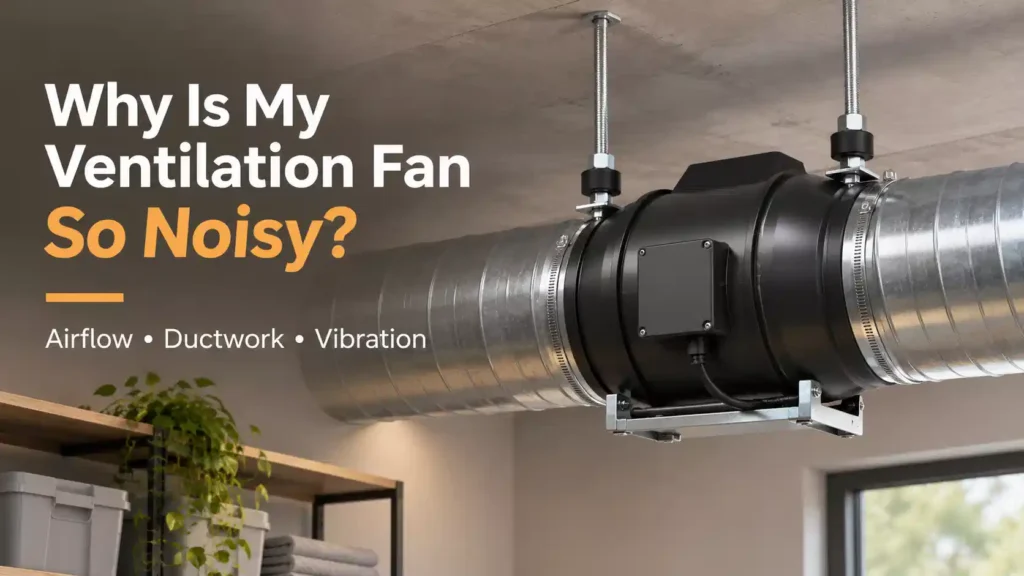
You buy a ventilation fan with a relatively low noise rating, install it, and switch it on. But instead of quiet airflow, you hear a loud rushing sound, humming, or vibration.
Does this mean the fan is defective?
Not necessarily.
A noisy ventilation fan can result from several factors beyond the motor itself. Duct layout, airflow resistance, mounting conditions, and operating speed all influence how a ventilation system sounds.
Understanding the source of the noise is the first step toward solving it.
Where Does Ventilation Fan Noise Come From?
Not all fan noise sounds the same, and different sounds can point to different problems.
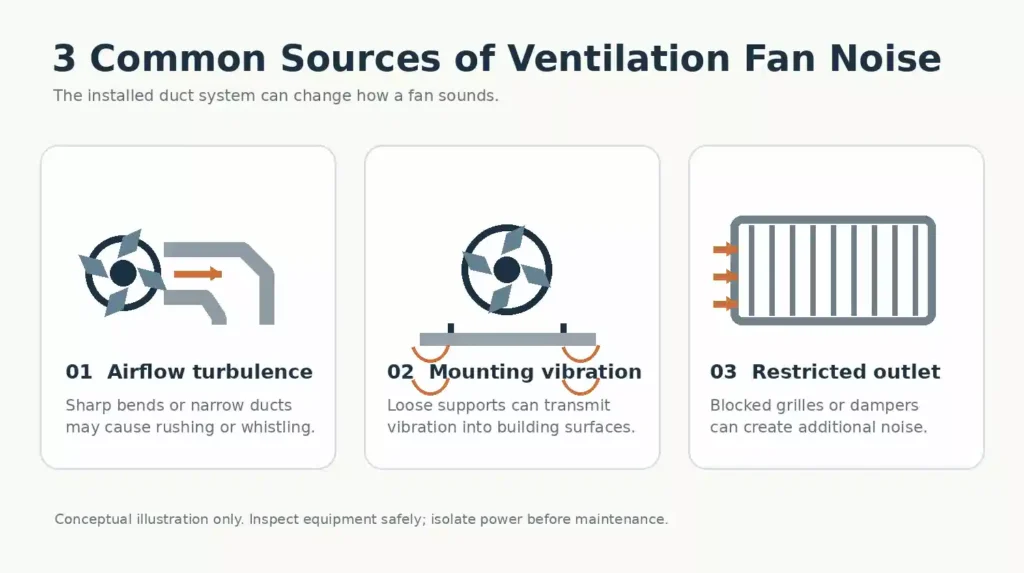
Motor and mechanical noise
The motor, bearings, and other moving components generate sound during operation. Unusual grinding, scraping, or persistent rattling may indicate a mechanical issue.
Airflow noise
Air passing through a fan, duct, or grille can create a rushing or whistling sound. This becomes more noticeable when airflow velocity is high or the air encounters restrictive fittings.
Vibration noise
If a running fan transfers vibration into a wall, ceiling, or rigid duct, the surrounding structure may amplify the sound.
A fan that sounds acceptable during a product demonstration can therefore behave differently after installation.
Five Common Causes of Excessive Fan Noise
1. Ducts That Are Too Small
A small duct forces air to travel faster at a given airflow rate.
Higher air velocity can increase friction, turbulence, and airflow-generated noise.
Connecting a larger fan to a much smaller duct may also create additional system resistance, affecting both airflow and sound.
Matching the duct size to the required airflow is often more effective than simply selecting a quieter fan.
2. Sharp Elbows Close to the Fan
Air leaving a fan is not always perfectly uniform.
If the duct immediately turns through a sharp elbow, the airflow may become more disturbed.
This can generate extra noise and pressure loss.
Where space allows, providing suitable straight duct sections and using smoother bends can improve airflow conditions.
3. Loose Mounting or Vibration Transfer
A fan mounted directly to lightweight framing may transmit vibration into the building.
Loose fasteners or poorly supported ductwork can make the problem worse.
Depending on the equipment and installation, properly selected vibration isolators, mounting supports, or flexible connectors may help.
Any isolation method must still maintain safe mechanical support and follow the manufacturer’s instructions.
4. Restricted Grilles or Dampers
A dirty grille, partially closed damper, or obstructed outlet can increase resistance.
Some restrictions also produce their own whistling or rattling sounds.
Inspect accessible air inlets and outlets for obvious blockages.
If the fan has recently become louder, a change in the duct or terminal condition may be responsible.
5. Operating at an Unsuitable Speed
Higher fan speeds can create more aerodynamic noise, although the relationship depends on the fan and system.
Running a fan at maximum speed when less airflow is required may produce unnecessary noise.
Where compatible speed control is available, adjusting the speed can sometimes improve acoustic comfort.
However, the reduced setting must still deliver sufficient ventilation airflow.
Does a Lower dBA Rating Always Mean a Quieter Installation?
Not necessarily.
Fan sound ratings depend on measurement conditions, distance, operating point, and the type of acoustic data reported.
Two products should not be compared using their published dBA figures alone unless the ratings are based on comparable test methods and conditions.
Sound power and sound pressure are also different measurements.
Sound power describes acoustic energy emitted by a source, while sound pressure describes the sound at a particular location.
In an actual installation, walls, ceilings, ducts, and room acoustics can change the sound experienced by occupants.
This is why sound data should be reviewed alongside airflow and pressure performance.
Practical Ways to Reduce Ventilation Noise
Before replacing the fan, check the installation systematically.
- Inspect grilles, ducts, and dampers for restrictions.
- Check that the fan and ductwork are securely supported.
- Avoid unnecessarily sharp bends close to the fan.
- Use appropriately sized ducts and smooth transitions.
- Consider suitable vibration isolation when structure-borne noise is present.
- Verify that the fan operates at the required airflow and pressure.
If the fan produces unusual grinding, scraping, electrical buzzing, or signs of overheating, stop using it and arrange professional inspection.
Always disconnect and isolate electrical power before maintenance.
A Quieter System Starts With Better Design
Choosing a low-noise fan matters, but it is only one part of the solution.
A well-matched fan, correctly sized ductwork, smooth airflow paths, and secure mounting can all contribute to quieter operation.
Before assuming a noisy fan needs replacing, investigate how the complete ventilation system is installed.
Sometimes, improving the surrounding ductwork makes more sense than buying a different motor or a larger fan.