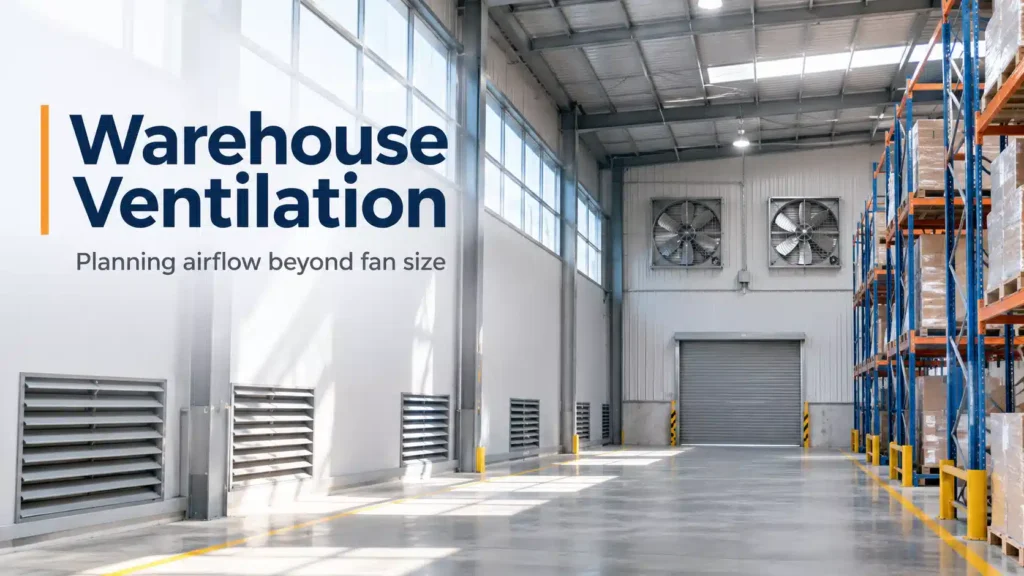
A warehouse may have several exhaust fans running throughout the day, yet some areas still feel hot and poorly ventilated. Why?
The issue isn’t always insufficient fan capacity. In many cases, the building layout, air inlet locations, and airflow paths are just as important.
Good warehouse ventilation means getting air to move through the right areas, not simply moving as much air as possible.
Why Warehouse Ventilation Matters
Warehouses often have high ceilings, large open areas, and rows of storage racks. These features can make airflow distribution difficult.
During warm weather, heat may accumulate near the roof, while packing areas or storage aisles receive little air movement.
Proper ventilation can help remove accumulated heat, moisture, and some airborne pollutants while supporting a more suitable working environment.
However, ventilation requirements vary depending on the building’s activities. A general storage warehouse will have different needs from a facility handling chemicals or industrial fumes.
Air Circulation vs. Ventilation: What’s the Difference?
Air circulation and ventilation serve different purposes.
Air circulation moves air within the building. Circulation fans can help reduce stagnant areas, but they do not necessarily replace indoor air with outdoor air.
Ventilation involves introducing suitable replacement air and removing indoor air through an exhaust system.
For example, wall-mounted exhaust fans can remove warm indoor air, while properly positioned intake openings allow outdoor air to enter.
Both parts are important.
Without adequate replacement air, exhaust fans may create excessive negative pressure and deliver less airflow than expected.
Where Should Warehouse Exhaust Fans Be Installed?
Fan placement depends on the building’s layout and ventilation objectives.
For general heat removal, high-level exhaust fans may help remove warm air that accumulates near the roof.
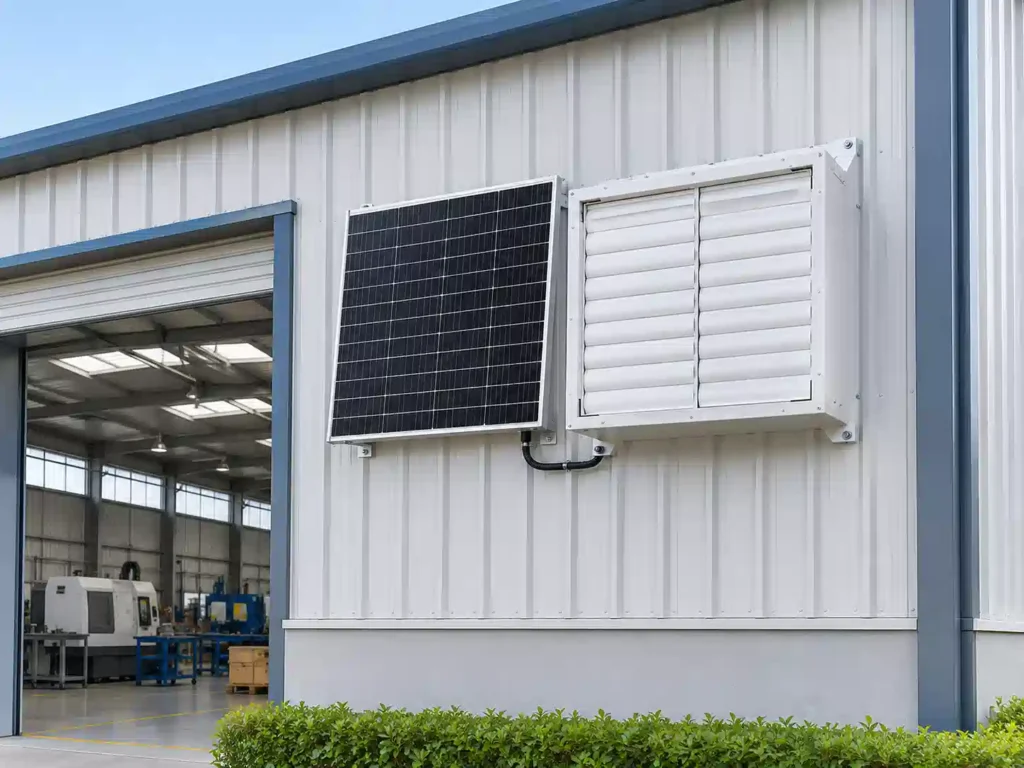
Wall-mounted exhaust fans can also be used to move air out of the building, particularly when suitable intake openings are available.
A practical arrangement often involves positioning air inlets and exhaust outlets to encourage airflow through the intended areas.
However, installing an inlet too close to an exhaust fan may cause incoming air to leave the building without reaching the spaces that need ventilation.
Tall storage racks, interior partitions, and large loading doors can also affect airflow patterns.
The goal is to create a suitable air path through the building rather than simply placing fans wherever installation is easiest.
Choosing the Right Fan for Your Warehouse
Different warehouse ventilation systems require different types of fans.
| Fan Type | Typical Application |
|---|---|
| Wall-Mounted Exhaust Fan | General exhaust through exterior walls |
| Roof Exhaust Fan | Removing air through roof-mounted outlets |
| Inline Duct Fan | Moving air through a dedicated duct system |
| Air Circulation Fan | Improving air movement within the building |
For large open spaces, wall-mounted or roof exhaust fans may be suitable, depending on the building design.
An inline duct fan can be useful when air needs to travel through ductwork from a specific location to an exhaust outlet.
When choosing equipment, consider more than the maximum airflow rating.
Duct resistance, installation conditions, operating noise, and the required airflow all influence the final selection.
A high-airflow fan is not necessarily the best option if it cannot perform effectively under the building’s actual conditions.
How Much Airflow Does a Warehouse Need?
Warehouse ventilation requirements depend on floor area, ceiling height, occupancy, internal heat sources, and building activities.
One common measurement is air changes per hour (ACH).
For a system exchanging indoor air with outdoor air:
ACH = Outdoor Airflow (m³/h) ÷ Building Volume (m³)
For example, a warehouse measuring 500 m² with a ceiling height of 6 m has a volume of 3,000 m³.
If the ventilation system provides 6,000 m³/h of effective outdoor-air exchange, the nominal ventilation rate is 2 ACH.
This is only a calculation example, not a recommended ACH value for every warehouse.
Actual requirements must be determined according to the building’s use and applicable standards. ACH alone also cannot guarantee uniform airflow throughout the warehouse.
Practical Tips for Better Warehouse Airflow
Before adding more exhaust fans, review the existing ventilation arrangement.
- Make sure sufficient replacement air can enter the building.
- Avoid placing intake and exhaust openings too close together.
- Consider how storage racks affect airflow through working areas.
- Keep exhaust openings clear of unnecessary obstructions.
- Select fans based on the required airflow and operating pressure.
- Inspect and maintain ventilation equipment regularly.
If a warehouse contains hazardous fumes, combustible dust, or chemical emissions, general exhaust ventilation alone may not be suitable. These applications may require professionally designed local exhaust systems.
Building a More Effective Ventilation System
Effective warehouse ventilation starts with understanding how air moves through the building.
The number of fans matters, but so do their locations, the available air inlets, and the arrangement of storage and working areas.
By considering these factors together, warehouse operators can make better equipment decisions and create a ventilation system suited to their actual needs.