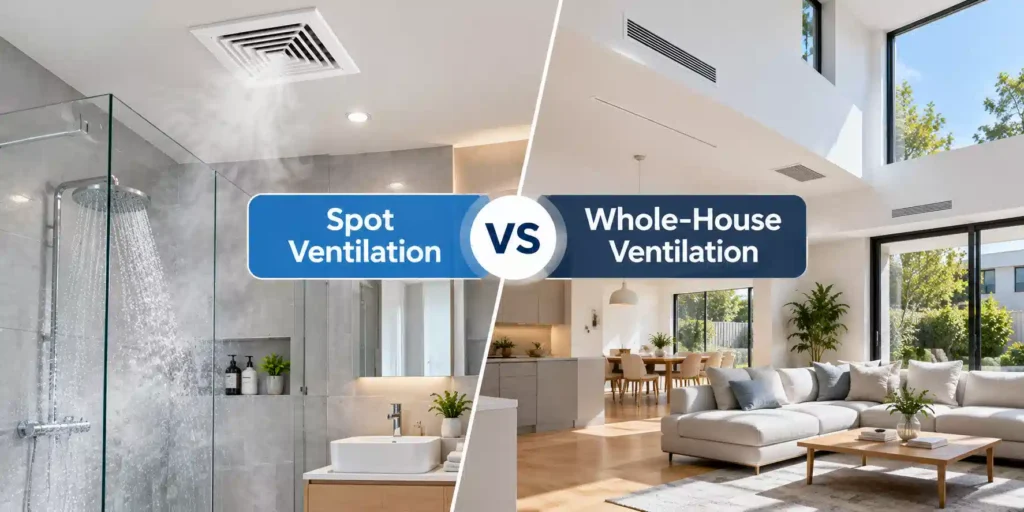
Not every ventilation problem requires the same solution.
A bathroom filled with steam after a shower has different ventilation needs from a home that feels stuffy throughout the day. In one case, the priority is removing moisture from a specific room. In the other, the building may need a more consistent exchange of indoor and outdoor air.
This is the difference between spot ventilation and whole-house ventilation.
Spot Ventilation: Dealing With Air Problems at the Source
Spot ventilation, also called local exhaust ventilation, removes air from a particular area where moisture, odors, or pollutants are generated.
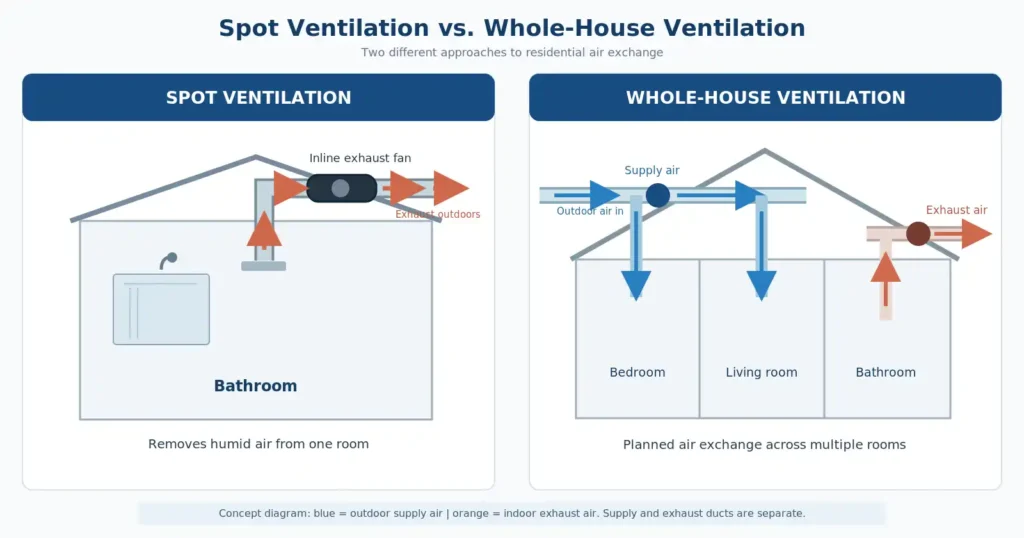
A familiar example is a bathroom exhaust system. When someone takes a hot shower, the exhaust fan helps remove humid air before it spreads to other parts of the home.
Other examples include suitable utility-room exhaust systems and dedicated kitchen range hoods.
Spot ventilation is especially useful because it addresses a problem close to its source rather than waiting for pollutants to spread throughout the building.
An inline duct fan can be part of a local exhaust system, with the fan installed along the duct instead of directly behind the room grille.
However, ordinary inline duct fans should not be used as substitutes for grease-rated kitchen exhaust equipment.
Whole-House Ventilation: Looking at the Bigger Picture
Whole-house ventilation has a broader purpose.
Instead of focusing on one room, it provides planned air exchange for the occupied areas of a home.
Depending on the design, the system may use mechanical exhaust, outdoor air supply, or a balanced combination of both.
Whole-house ventilation is particularly relevant in relatively airtight buildings, where relying on uncontrolled air leakage may not provide sufficient ventilation.
These systems are commonly designed to operate continuously or at scheduled intervals.
The goal is consistent air exchange, not simply moving indoor air from one room to another.
How Do They Compare?
Neither approach replaces the other in every situation.
For example, a whole-house ventilation system may provide ongoing air exchange, while a separate bathroom exhaust system handles temporary increases in moisture.
Where Does an Inline Duct Fan Fit In?
Inline duct fans offer flexibility because they can be installed within compatible ductwork.
For local ventilation, a fan may connect a bathroom exhaust grille to an outdoor termination.
In a larger ventilation arrangement, a suitably selected fan may help move air through a dedicated supply or exhaust duct.
However, the fan itself does not determine whether a system provides whole-house ventilation.
That depends on factors such as:
- Required ventilation airflow
- Location of air inlets and outlets
- Duct layout and pressure resistance
- Outdoor air supply arrangements
- Controls and operating schedules
A correctly sized fan is only one part of the overall system.
Which Approach Does Your Home Need?
If the main problem is humidity in a bathroom, localized exhaust ventilation may be the appropriate starting point.
If several rooms regularly feel stuffy, a more comprehensive ventilation assessment may be useful.
Many homes benefit from combining local exhaust systems with a planned approach to general outdoor air exchange.
Before selecting equipment, identify the problem you want to solve and consider how air will enter, move through, and leave the building.
A Better Ventilation Plan Starts With the Right Purpose
Spot ventilation and whole-house ventilation serve different but complementary roles.
One targets pollutants and moisture where they are produced. The other helps maintain general air exchange throughout the home.
Understanding this distinction makes it easier to select suitable ventilation equipment, plan ductwork, and avoid expecting a single exhaust fan to solve every indoor air problem.