
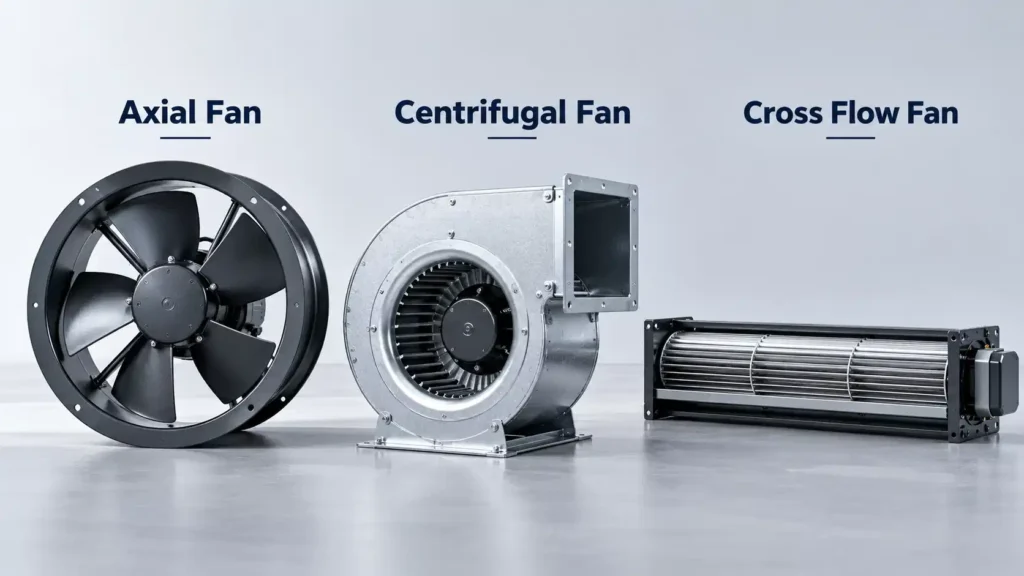
A wall-mounted exhaust fan, a blower inside an air handling unit, and the long fan inside an air curtain may look completely different. Yet they all perform the same basic task: moving air.
The main difference lies in how air travels through the rotating impeller.
Three common designs are axial fans, centrifugal fans, and cross flow fans. Understanding their operating principles can make it easier to choose suitable ventilation equipment.
1. Axial Fans: Moving Air Straight Through
An axial fan moves air primarily parallel to its rotating shaft. Air enters from one side of the impeller and leaves from the other, much like a propeller pushing air forward.
This straightforward design is commonly found in wall exhaust fans, cooling fans, and general ventilation equipment.
Where Are Axial Fans Used?
Axial fans are frequently used in:
- Wall-mounted exhaust ventilation
- Industrial and agricultural ventilation
- Equipment and electronic cooling
- General air circulation
Their main advantage is moving relatively large volumes of air where system resistance is low.
However, not all axial fans have the same pressure capability. Specialized tubeaxial and vaneaxial models can handle higher resistance than simple propeller fans.
2. Centrifugal Fans: Changing the Direction of Airflow
A centrifugal fan works differently.
Air typically enters near the center of the impeller, parallel to its shaft. As the wheel rotates, the air moves outward toward the perimeter of the impeller.
The airflow therefore changes direction from axial to radial. A surrounding housing may collect and guide this air toward a discharge outlet.
Centrifugal fans are particularly useful when the system must overcome substantial airflow resistance.
Where Are Centrifugal Fans Used?
Typical applications include:
- Air handling units
- Commercial HVAC duct systems
- Industrial ventilation and extraction
- Ventilation systems with restrictive components
Their ability to develop relatively high pressure makes them suitable for many ducted applications.
That said, centrifugal fans are not automatically more efficient or quieter than axial fans. Actual performance depends on impeller design, fan size, speed, and operating conditions.
3. Cross Flow Fans: Creating a Wide Air Stream
Cross flow fans, also called tangential fans, have a distinctive long, cylindrical impeller.
Instead of moving air along the shaft, air enters through one side of the cylindrical wheel, passes through the impeller region, and exits from another side.
The air passes through the blade region twice, producing a broad airflow across the length of the fan.
This makes cross flow fans useful where air must be distributed evenly along a wide outlet.
Where Are Cross Flow Fans Used?
Common examples include:
- Air curtains
- Indoor air-conditioning units
- Electric heaters and convectors
- Cooling systems requiring wide airflow distribution
Cross flow fans typically work best in applications with relatively low airflow resistance.
Their long, narrow design is especially practical in equipment where a wide, uniform air stream is more important than high static pressure.
Comparing the Three Fan Types
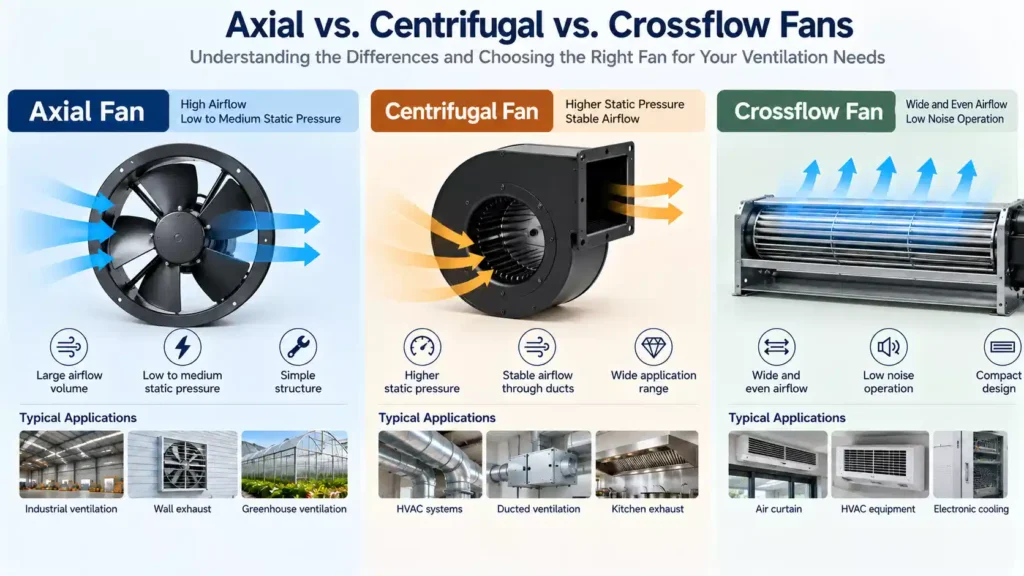
These are general characteristics, not fixed performance rankings. Different models within the same category can have significantly different airflow, pressure, noise, and efficiency ratings.
Which Fan Type Should You Choose?
The best fan depends on what the ventilation system needs to accomplish.
For a relatively open exhaust installation, an appropriately selected axial fan may provide the required airflow.
For a duct system with significant resistance, a centrifugal fan may offer a more suitable pressure-performance characteristic.
For equipment requiring airflow across a long, narrow opening, a cross flow fan is often a practical choice.
Before selecting any fan, check the required airflow, static pressure, installation dimensions, operating noise, and manufacturer performance data.
Also remember that mixed flow fans combine aspects of axial and centrifugal designs. They are another option for certain ducted ventilation applications, although they are not the focus of this comparison.
Understanding the Design Makes Selection Easier
Axial fans move air mainly along the shaft. Centrifugal fans redirect air outward from the impeller center. Cross flow fans distribute air across the width of a cylindrical wheel.
Each design solves a different airflow problem.
Rather than choosing a fan based only on appearance or motor power, matching its airflow characteristics to the actual application is the more reliable approach.