
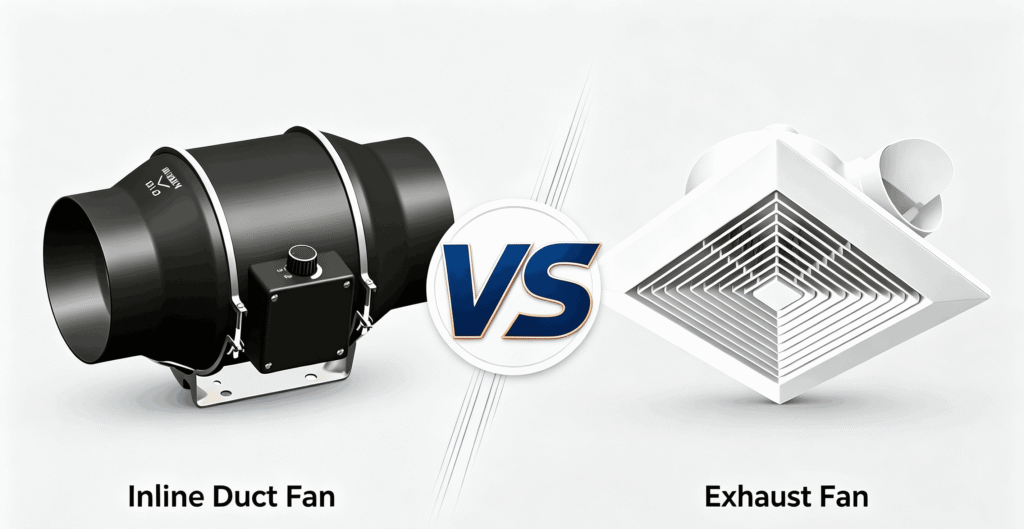
When choosing a ventilation fan, you may wonder whether you need an inline duct fan or a traditional exhaust fan.
Both are used to remove unwanted air, moisture, odors, and heat, but they have different installation methods and applications.
What Is an Inline Duct Fan?
An inline duct fan is installed inside a ventilation duct.
A typical system is:
Room → Grille → Duct → Inline Fan → Duct → Outside
Because the fan is installed within the ductwork, it can be positioned away from the occupied space.
Inline duct fans are commonly used in residential, commercial, and industrial ventilation systems.
What Is an Exhaust Fan?
An exhaust fan is usually installed directly on a wall, ceiling, or window to remove air from a room.
A typical system is:
Room → Exhaust Fan → Outside
Exhaust fans are commonly used in bathrooms, toilets, kitchens, and other small rooms where direct exhaust is required.
Inline Duct Fan vs Exhaust Fan
| Feature | Inline Duct Fan | Exhaust Fan |
|---|---|---|
| Installation | Inside ductwork | Wall, ceiling, or window |
| Ductwork | Required | Usually minimal |
| Installation flexibility | High | Simple |
| Long duct runs | More suitable | Depends on the fan |
| Multiple rooms | Possible | Usually one room |
| Noise | Can be installed away from the room | Usually closer to the room |
| Typical use | Ducted ventilation | Direct exhaust |
Installation
The main difference is where the fan is installed.
An inline duct fan is installed within the duct system, while an exhaust fan is normally installed directly at the exhaust point.
If your project already has a ductwork system, an inline fan can provide greater installation flexibility.
Airflow and Static Pressure
For ducted ventilation, you should consider both airflow and static pressure.
Long ducts, elbows, filters, grilles, and dampers can increase system resistance and reduce actual airflow.
Therefore, a fan should not be selected based only on its maximum CFM rating.
The required airflow should be considered together with the system’s static pressure.
Which One Should You Choose?
An exhaust fan may be suitable when:
- The room is small
- The exhaust path is short
- Direct wall or ceiling installation is possible
- A simple ventilation solution is required
An inline duct fan may be a better choice when:
- The system uses ductwork
- The duct run is longer
- Multiple ventilation points are required
- The fan needs to be installed away from the occupied space
- More installation flexibility is needed
In simple terms:
Simple direct exhaust → Exhaust Fan
Ducted ventilation system → Inline Duct Fan
Frequently Asked Questions
Is an inline duct fan the same as an exhaust fan?
No. An inline duct fan is installed inside ductwork, while an exhaust fan is usually installed directly at the air exhaust point.
Can an inline duct fan be used as an exhaust fan?
Yes. An inline duct fan can be installed in a duct system to move air from a room and discharge it outside.
Are inline duct fans better than exhaust fans?
Neither is always better. The right choice depends on the ductwork, airflow requirements, static pressure, installation space, and application.
Conclusion
The choice between an inline duct fan and an exhaust fan depends mainly on your ventilation system.
For simple and direct room ventilation, an exhaust fan may be sufficient.
For ducted systems or applications requiring more installation flexibility, an inline duct fan may be the better option.
Before choosing a fan, consider airflow, static pressure, duct size, and the actual application.