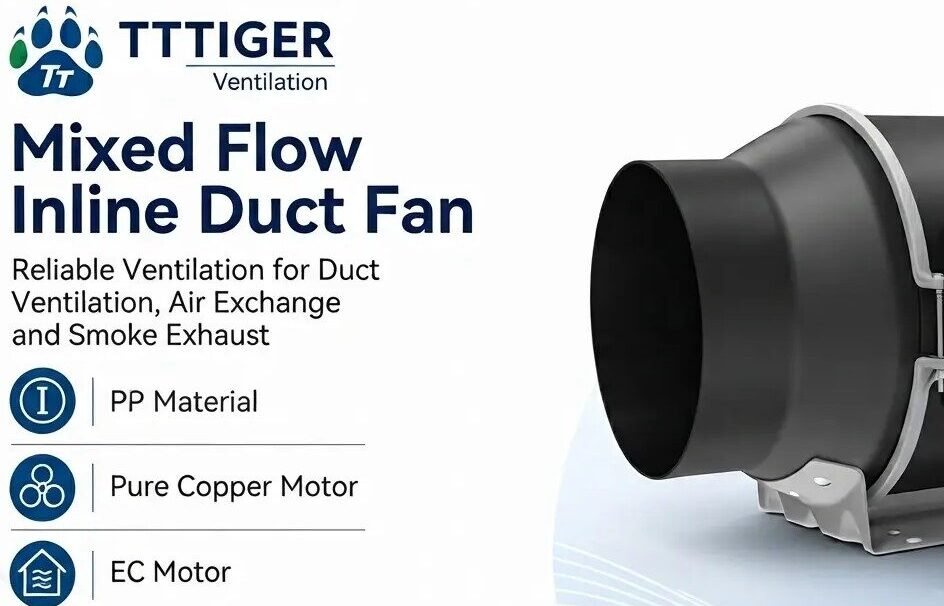
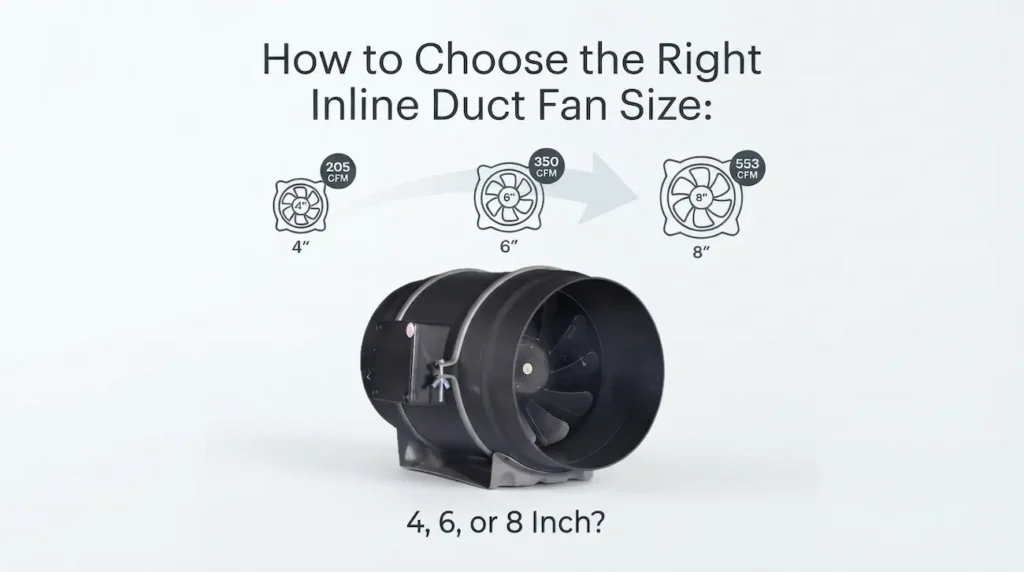
Choosing the right inline duct fan is important for an effective ventilation system. The most common sizes for many applications are 4 inch, 6 inch, and 8 inch.
The right choice depends not only on duct size, but also on required airflow, static pressure, and application.
4 Inch Inline Duct Fan
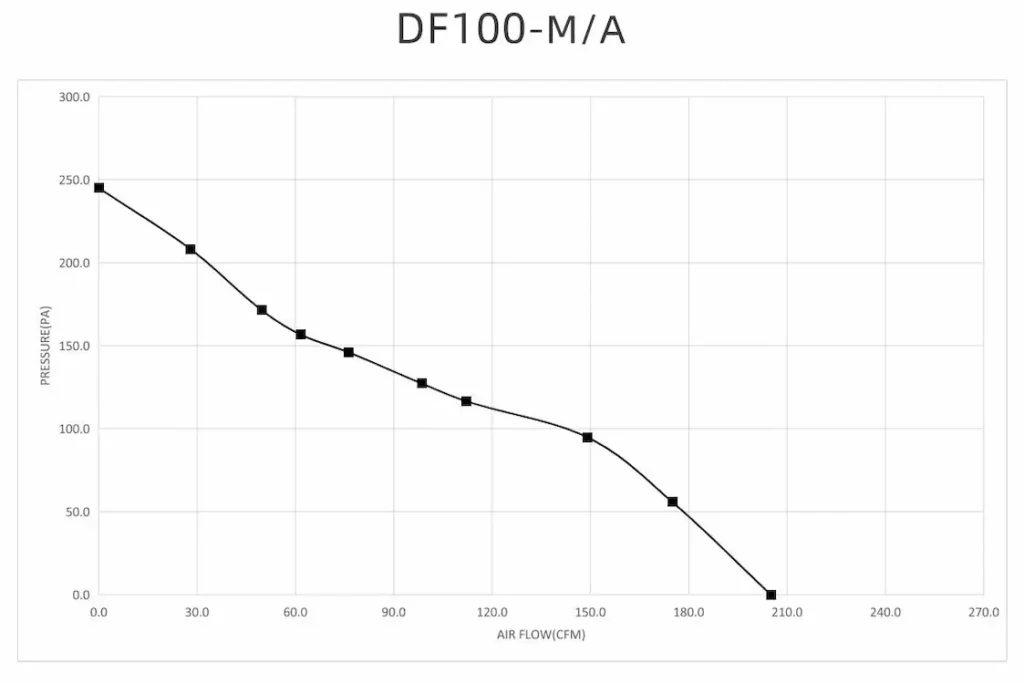
The DF100-M is a compact 4 inch EC inline duct fan designed for smaller ventilation systems.
| Specification | DF100-M |
|---|---|
| Motor | EC |
| Power | 25 W |
| Speed | 2600 RPM |
| Airflow | 205 CFM |
| Static Pressure | 245 Pa |
| Noise | 26 dBA |
It can be used for small growing spaces, cabinets, rooms, and other applications with relatively low airflow requirements.
6 Inch Inline Duct Fan
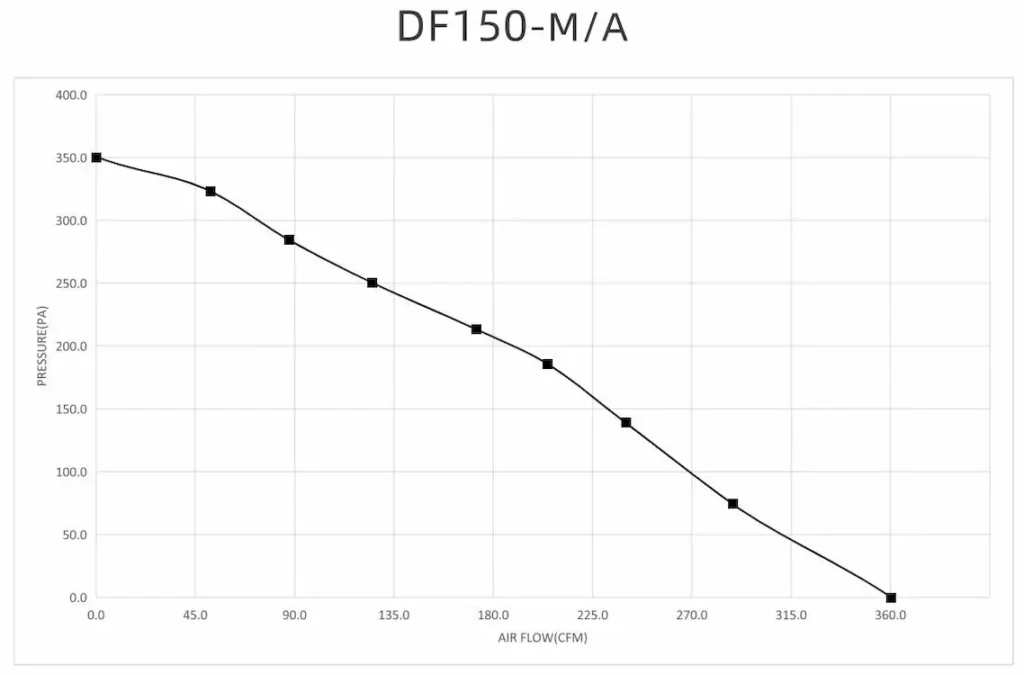
The DF150-M provides higher airflow than the 4 inch model and is suitable for medium-sized ventilation systems.
| Specification | DF150-M |
|---|---|
| Motor | EC |
| Power | 50 W |
| Speed | 2500 RPM |
| Airflow | 350 CFM |
| Static Pressure | 360 Pa |
| Noise | 32 dBA |
The 6 inch fan can be used for hydroponics, indoor growing, greenhouse ventilation, workshops, and general ventilation.
8 Inch Inline Duct Fan
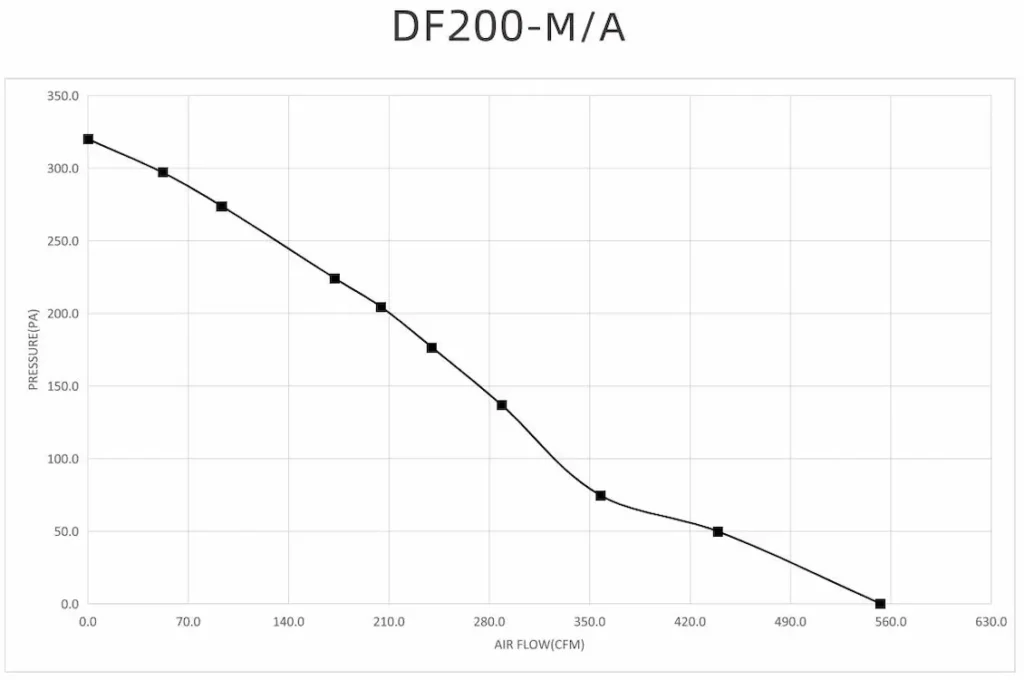
The DF200-M is an 8 inch EC inline duct fan designed for applications requiring higher airflow.
| Specification | DF200-M |
|---|---|
| Motor | EC |
| Power | 70 W |
| Speed | 2000 RPM |
| Airflow | 553 CFM |
| Static Pressure | 320 Pa |
| Noise | 32 dBA |
It is suitable for larger growing areas, greenhouses, commercial ventilation, warehouses, and other applications requiring greater air movement.
4 Inch vs 6 Inch vs 8 Inch Inline Duct Fan
| Model | Size | Airflow | Static Pressure | Power | Noise |
|---|---|---|---|---|---|
| DF100-M | 4 inch | 205 CFM | 245 Pa | 25 W | 26 dBA |
| DF150-M | 6 inch | 350 CFM | 360 Pa | 50 W | 32 dBA |
| DF200-M | 8 inch | 553 CFM | 320 Pa | 70 W | 32 dBA |
Generally, a 4 inch fan is suitable for smaller systems, a 6 inch fan for medium airflow requirements, and an 8 inch fan for higher airflow applications.
Don’t Forget Static Pressure
Duct length, bends, filters, and other components create resistance in a ventilation system. This resistance affects the actual airflow of the fan.
Therefore, don’t choose a fan based only on its maximum CFM. Check the fan performance curve to see how much airflow the fan can provide at the required static pressure.
How to Choose the Right Size?
Before selecting an inline duct fan, consider:
- Required airflow (CFM)
- Duct diameter
- Static pressure
- Duct length and bends
- Filters or other restrictions
- Application and operating hours
For example, if your system requires around 200 CFM, a 4 inch model may be suitable. For higher airflow requirements, a 6 or 8 inch model may be more appropriate.
Conclusion
Choosing the right inline duct fan requires more than simply matching the duct diameter. Airflow, static pressure, and application should all be considered.
Our 4 inch DF100-M, 6 inch DF150-M, and 8 inch DF200-M EC inline duct fans provide different airflow capacities for a range of ventilation applications.
If you are unsure which model to choose, contact us with your duct size, airflow requirement, and application.