Choosing the right exhaust fan for a warehouse is important for maintaining air circulation, removing excess heat, and improving indoor air quality. However, selecting a fan based only on its size or maximum airflow can lead to poor ventilation performance.
Before choosing an exhaust fan, consider the warehouse layout, ventilation requirements, installation location, and resistance to airflow.
1. Determine the Ventilation Requirements
Start by identifying why the warehouse needs ventilation.
Common reasons include:
- Removing heat accumulated inside the building
- Exhausting stale air and unwanted odors
- Improving general air circulation
- Removing airborne contaminants where appropriate extraction systems are required
Different applications require different ventilation solutions. A warehouse that mainly needs heat removal may have different requirements from a workshop that produces dust, fumes, or other contaminants.
For hazardous fumes or combustible dust, a standard exhaust fan may not be suitable. The system must be designed for the specific hazard and applicable safety requirements.
2. Calculate the Required Airflow
Airflow is usually measured in CFM (cubic feet per minute) or m³/h (cubic meters per hour).
One common starting point is the air change rate, which describes how many times the air volume of a space is replaced each hour.
A basic estimate is:
Required Airflow (m³/h) = Room Volume (m³) × Air Changes per Hour
For example, a warehouse measuring 20 m long, 10 m wide, and 5 m high has a volume of 1,000 m³.
If the design target is 4 air changes per hour, the estimated airflow requirement would be:
1,000 × 4 = 4,000 m³/h
This is only an initial estimate. The appropriate air change rate depends on the building, heat load, occupancy, and ventilation purpose. Actual system design should also account for air distribution and fan performance under operating conditions.
3. Consider Static Pressure
A fan’s advertised maximum airflow does not necessarily represent the airflow it will deliver after installation.
Air must pass through the fan’s inlet, outlet, louvers, screens, ducts, and other components. These create resistance, commonly described as static pressure.
For a simple wall-mounted exhaust fan with a short discharge path, resistance may be relatively low. A ducted system with long ducts, multiple bends, or filters may require a fan capable of handling higher static pressure.
Always consider the complete ventilation system when comparing fan specifications.
4. Choose the Right Installation Location
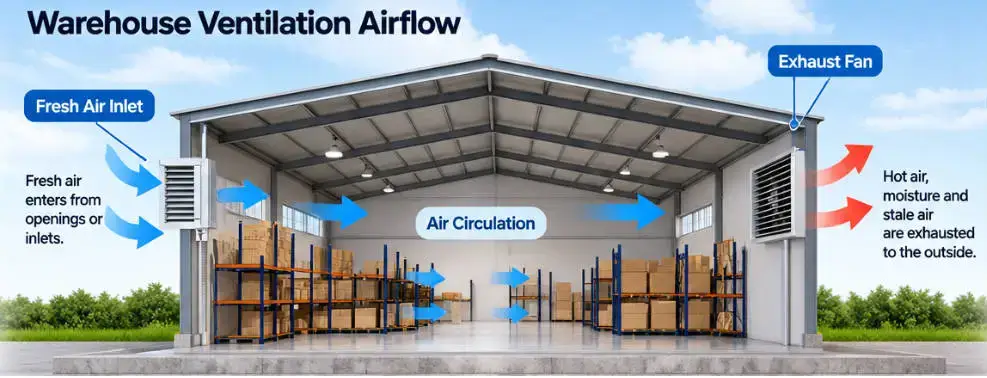
The position of an exhaust fan affects how effectively it removes warm or stale air.
For many warehouses, wall-mounted exhaust fans are practical because they discharge air directly outdoors and can simplify installation.
However, exhaust air must be replaced by fresh air entering through suitable openings or a designed air supply system. Without sufficient replacement air, the exhaust fan may not achieve its expected performance.
Consider the location of doors, windows, air inlets, work areas, and potential obstructions before deciding where to install the fan.
5. Select a Suitable Fan Type
Different fan designs suit different ventilation requirements.
Metal louvered exhaust fans are commonly used for general ventilation in warehouses, workshops, and industrial buildings. The louvers help cover the opening when the fan is not operating, depending on the design.
Axial fans are often suitable for moving relatively large volumes of air against low system resistance.
Centrifugal fans are often considered when the system requires higher pressure, such as in ductwork or systems with more restrictive components.
The best option depends on the required airflow, static pressure, installation conditions, and type of air being exhausted.
6. Check Power, Noise, and Maintenance
Airflow is important, but it is not the only factor.
Before purchasing, compare:
- Power consumption: Check the rated power and expected operating hours.
- Noise level: Consider nearby offices, occupied work areas, and local noise requirements.
- Construction: Choose materials and protection suitable for the installation environment.
- Maintenance: Make sure the fan, blades, motor, and louvers can be inspected and cleaned.
- Electrical compatibility: Confirm that voltage and frequency match the site supply.
For warehouses operating fans for long periods, energy use and maintenance access can have a significant effect on operating costs.
7. Avoid Common Selection Mistakes
Several common mistakes can reduce ventilation performance:
- Choosing a fan based only on its diameter
- Comparing maximum airflow without considering static pressure
- Installing exhaust fans without sufficient replacement air
- Placing fans where airflow is obstructed
- Ignoring the building’s heat load or specific extraction requirements
A properly selected fan should match the building’s ventilation needs and the conditions under which it will operate.
Conclusion
Choosing an exhaust fan for a warehouse requires more than selecting a large fan with a high airflow rating. Room volume, ventilation purpose, static pressure, installation location, replacement air, and operating costs all matter.
By evaluating these factors before purchasing, warehouse operators and ventilation equipment distributors can make better-informed decisions and avoid common performance problems.