
Choosing an inline duct fan is only part of building an effective ventilation system. The duct connected to it matters just as much.
A common question is whether a 6-inch inline fan can be installed with a 4-inch duct. While adapters make this physically possible, reducing the duct diameter can change the system’s airflow performance.
Before choosing a duct size, it’s worth understanding what happens when air travels through a smaller opening.
Why Duct Diameter Matters
Airflow describes how much air moves through a system, while air velocity describes how fast it travels.
For a given airflow rate, a smaller duct has less cross-sectional area, so air must travel faster to carry the same volume.
Higher velocity can increase friction and pressure losses, particularly in long duct runs or systems with several bends.
It can also contribute to unwanted airflow noise.
This is why the right duct diameter is not simply a matter of whether the duct fits the fan outlet.
Can You Connect a 6-Inch Fan to a 4-Inch Duct?
Yes, a suitable reducer can connect the two sizes. However, that does not mean the fan will maintain its original airflow rating.
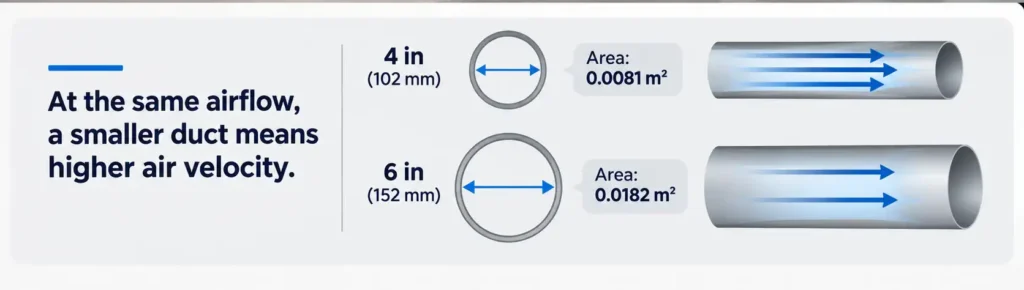
Consider a basic example.
| Duct Diameter | Cross-Sectional Area |
|---|---|
| 4 inches (102 mm) | Approx. 0.0081 m² |
| 6 inches (152 mm) | Approx. 0.0182 m² |
A 4-inch duct has less than half the cross-sectional area of a 6-inch duct.
At the same airflow rate, air velocity in the smaller duct would therefore be approximately 2.25 times higher.
In a real installation, the airflow may decrease as the increased resistance changes the fan’s operating point.
The exact reduction cannot be determined from duct diameter alone.
For this reason, reducing the duct size should only be considered after checking the fan performance curve and the complete system pressure loss.
What About Using a Larger Duct?
A larger duct generally reduces air velocity at the same airflow rate.
Under comparable installation conditions, this can help reduce friction losses and airflow-generated noise.
However, installing the largest possible duct is not always necessary or practical.
Larger ducts require more installation space and may increase material costs.
The goal is to select a size that provides the required airflow without excessive resistance, noise, or unnecessary expense.
Three Things to Check Before Installation
1. Fan connection size
Start with the manufacturer’s specified inlet and outlet diameters.
A matching duct connection is usually the most straightforward arrangement, provided it also meets the system’s airflow requirements.
2. Duct length and bends
Long ducts, sharp elbows, and restrictive fittings all add pressure losses.
A short, straight installation may perform differently from a long route with several turns, even when both use the same fan and duct diameter.
3. Actual airflow requirements
The duct size should support the airflow needed for the application.
An effective selection considers airflow, duct velocity, pressure losses, and the fan’s available pressure together.
If the system includes filters, dampers, or grilles, their resistance must also be included.
Does Flexible Ducting Change the Calculation?
Flexible ducts are convenient for certain installations, but they require careful routing.
Compressed sections, excessive bends, and poor support can create additional resistance.
Where flexible ducting is appropriate, keep it properly extended and supported according to the manufacturer’s instructions.
For some installations, smooth rigid ductwork can provide a more predictable airflow path.
The choice depends on the application, available space, and applicable installation requirements.
Getting the Duct Size Right
A fan’s connection diameter is a useful starting point, but it should not be the only consideration.
Smaller ducts can increase air velocity and resistance. Larger ducts can reduce these effects, but may not always be necessary.
For reliable performance, match the ductwork to the required airflow, the fan’s pressure capability, and the actual installation layout.
A well-matched fan and duct system is generally a better choice than trying to compensate for restrictive ductwork with a more powerful fan.