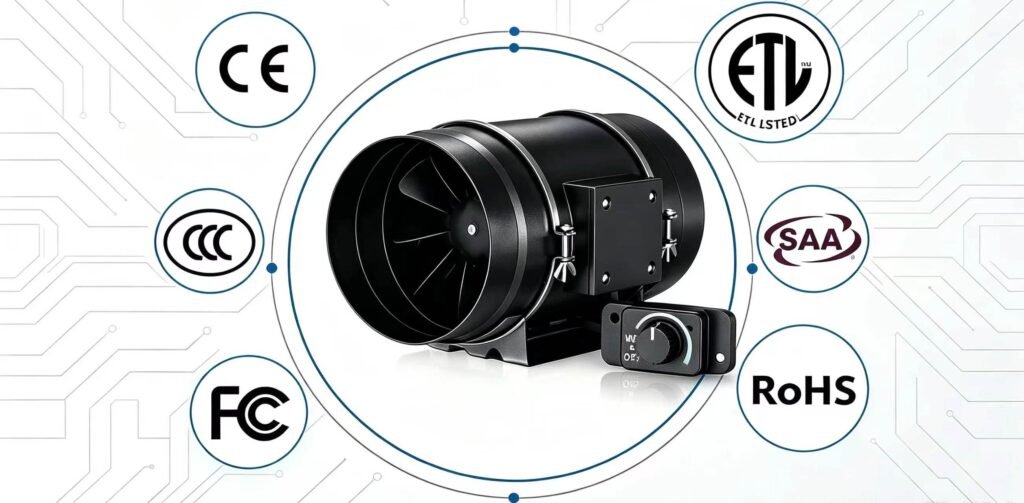
When buying or exporting ventilation fans, customers often ask about CE, UL, ETL, or RoHS. But these marks do not mean the same thing.
Understanding the difference can help you choose the right fan for your target market.
CE: Mainly for the European Market
CE stands for Conformité Européenne. It indicates that a product complies with applicable EU requirements.
For ventilation fans, CE compliance may involve requirements related to electrical safety, electromagnetic compatibility (EMC), and machinery-related requirements, where applicable.
CE marking is required when a fan falls under EU legislation that requires CE marking.
CE is not simply a general “quality certificate.” It is generally based on the manufacturer’s declaration of conformity, although some products require assessment by an EU notified body.
UL: Product Safety Certification
UL is a well-known safety certification organization in North America.
For ventilation fans, UL certification is often requested for products intended for the US or Canadian markets, especially for building and commercial projects.
UL certification focuses on product safety and evaluates products against applicable safety standards.
It is important to remember that CE certification does not automatically mean UL certification. They are separate requirements for different markets.
ETL: Another North American Safety Mark
ETL is a safety certification mark issued by Intertek.
Like UL, ETL is widely used in the North American market. ETL-listed products are tested and certified by Intertek to applicable safety standards. ETL is also an OSHA-recognized NRTL mark.
Therefore, when a customer asks for UL or ETL, the key question is not simply which mark is “better.”
Instead, check:
- Which country is the fan being sold in?
- What standard does the project require?
- Does the certification cover the exact fan model?
RoHS: Restriction of Hazardous Substances
RoHS stands for Restriction of Hazardous Substances.
Unlike UL and ETL, RoHS mainly focuses on restricting certain hazardous substances in electrical and electronic equipment.
For ventilation fans, RoHS compliance can involve materials and components such as motors, PCBs, wires, and electronic parts.
You may therefore see products described as CE + RoHS compliant. These two requirements cover different aspects of product compliance.
RoHS originated as an EU directive and similar restrictions have also been adopted in other regions.
CE vs UL vs ETL vs RoHS
| Mark | Main Focus | Common Market |
|---|---|---|
| CE | EU regulatory compliance | Europe |
| UL | Product safety | North America |
| ETL | Product safety | North America |
| RoHS | Hazardous substance restrictions | Europe and other markets |
Which Certification Does Your Fan Need?
No single certification covers all markets.
Before purchasing Exhaust fans or EC inline duct fan, it is best to confirm:
- Target country or market
- Fan application
- Required voltage
- Project or local certification requirements
- Required standards and documents
For example, a fan for the European market may require CE and RoHS compliance, while a North American project may specifically require UL or ETL certification.
The right certification depends on the market, application, and project requirements.
Final Thoughts
CE, UL, ETL, and RoHS are not interchangeable certifications.
CE mainly relates to applicable European requirements, UL and ETL focus on product safety certification in North America, while RoHS focuses on restricted hazardous substances.
For fan exporters, identifying the target market and certification requirements before production can help avoid unnecessary costs and ensure the right documentation is provided.