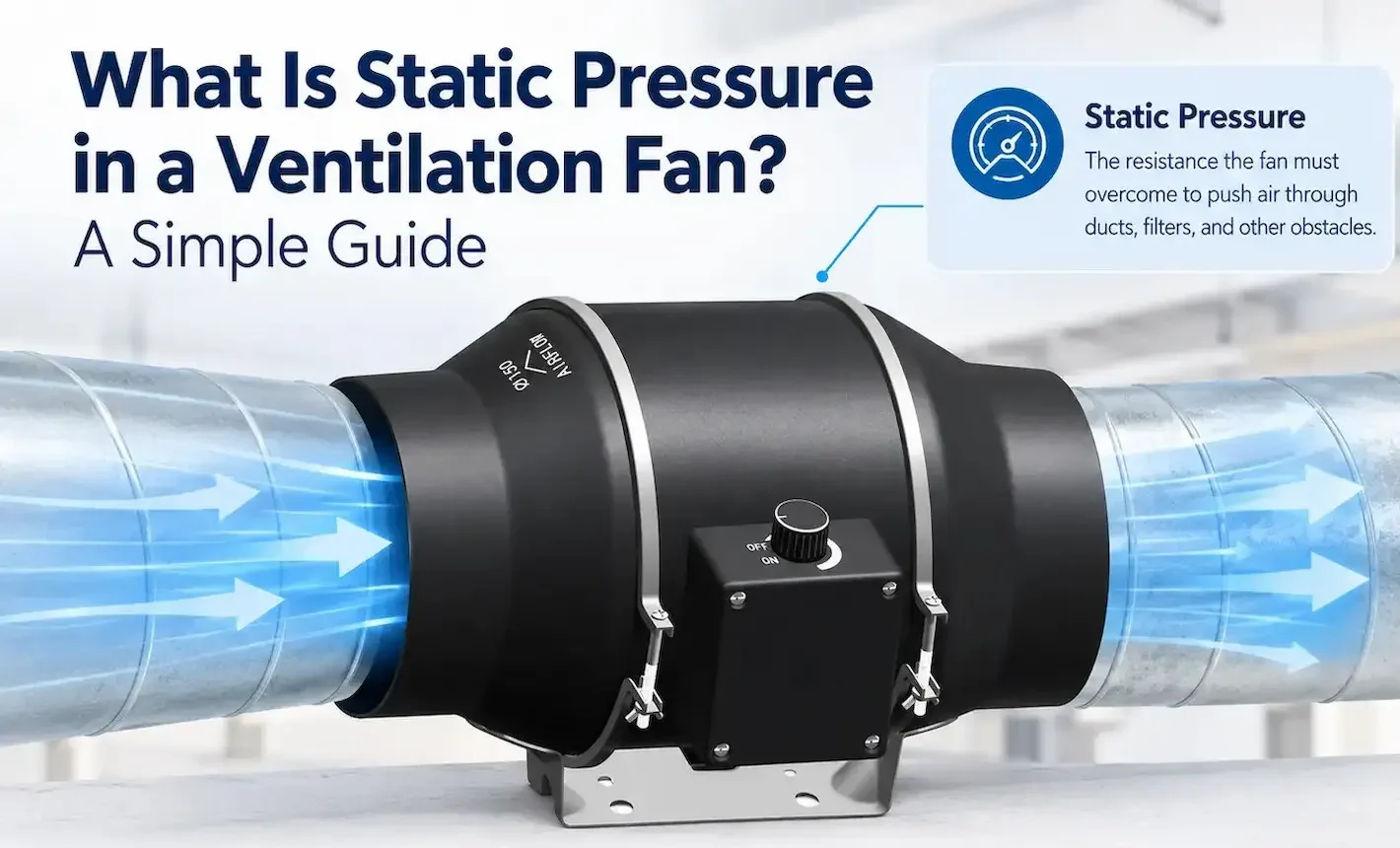
Indoor vertical farms run their air-handling continuously — often 20+ hours per day, 365 days per year. Fan energy alone can account for 12–18% of total facility electricity, second only to grow lights. Switching from conventional AC induction motors to EC (electronically commutated) motors is the single largest air-side efficiency lever available today.
Why EC outperforms AC at part load
AC induction motors operate near peak efficiency at full speed but lose 15–25% efficiency when speed-controlled with a VFD. EC motors maintain 88–92% efficiency across the entire 20–100% speed range because the commutation is electronic, not slip-based. Indoor farms rarely run fans at 100% — climate setpoints typically demand 40–70% airflow — so the EC advantage compounds.
Three-year TCO: 2,000 m² hydroponic facility
Reference design: 24 inline circulation fans (12-inch class), each rated to deliver 1,200 m³/h at 80 Pa. Operating profile: 22 h/day average, 50% average duty cycle. Electricity rate: $0.12/kWh.
| Metric | AC Induction | EC (TTTIGER) |
|---|---|---|
| Average input power per fan | 180 W | 95 W |
| Annual kWh per fan | 1,447 | 763 |
| 24-fan facility kWh/year | 34,728 | 18,312 |
| Annual electricity cost | $4,167 | $2,197 |
| Annual savings | — | $1,970 |
| Capex premium per fan | — | $140 |
| Total capex premium (24 fans) | — | $3,360 |
| Simple payback | — | 20 months |
| 3-year net savings | — | $2,550 |
Payback drops to 13–15 months in jurisdictions with electricity above $0.18/kWh (most of Europe, parts of California, Singapore). In subsidized agriculture markets it can extend to 28+ months.
Beyond electricity: the soft savings
EC fans run 4–6 dB(A) quieter at part load, which matters for staff comfort in enclosed grow rooms. They also produce roughly 45% less waste heat at typical duty cycles, reducing the load on chillers and dehumidifiers — a secondary saving of 8–12% on the cooling-system electricity bill that most TCO models ignore.
When AC still makes sense
- Fans that run 100% duty cycle continuously (no part-load advantage)
- Very small budgets where the capex premium genuinely cannot be financed
- Replacement-in-kind in legacy installations where re-controls are out of scope
- Hazardous-area applications where the EC controller cannot be ATEX-rated
For nearly every greenfield indoor farming or controlled-environment agriculture project, EC pays back inside two years and generates positive lifetime value of $80–140 per fan-watt over a 10-year horizon.