
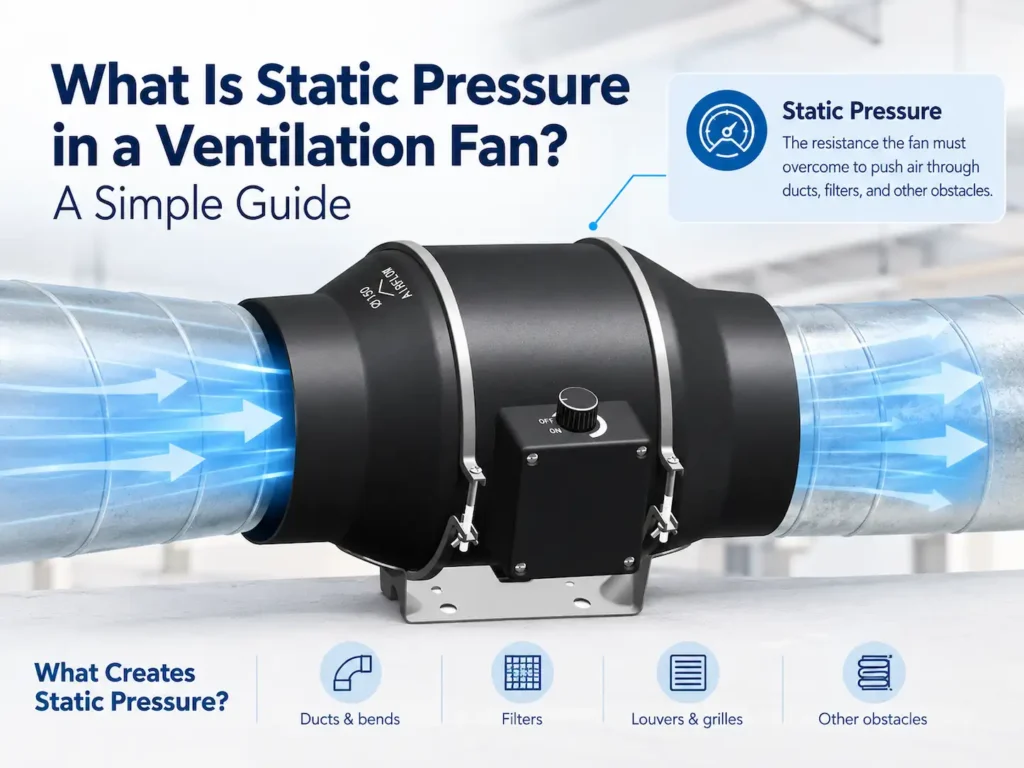
When choosing a ventilation fan, many buyers focus on airflow, usually measured in CFM or m³/h. However, airflow is only part of the picture.
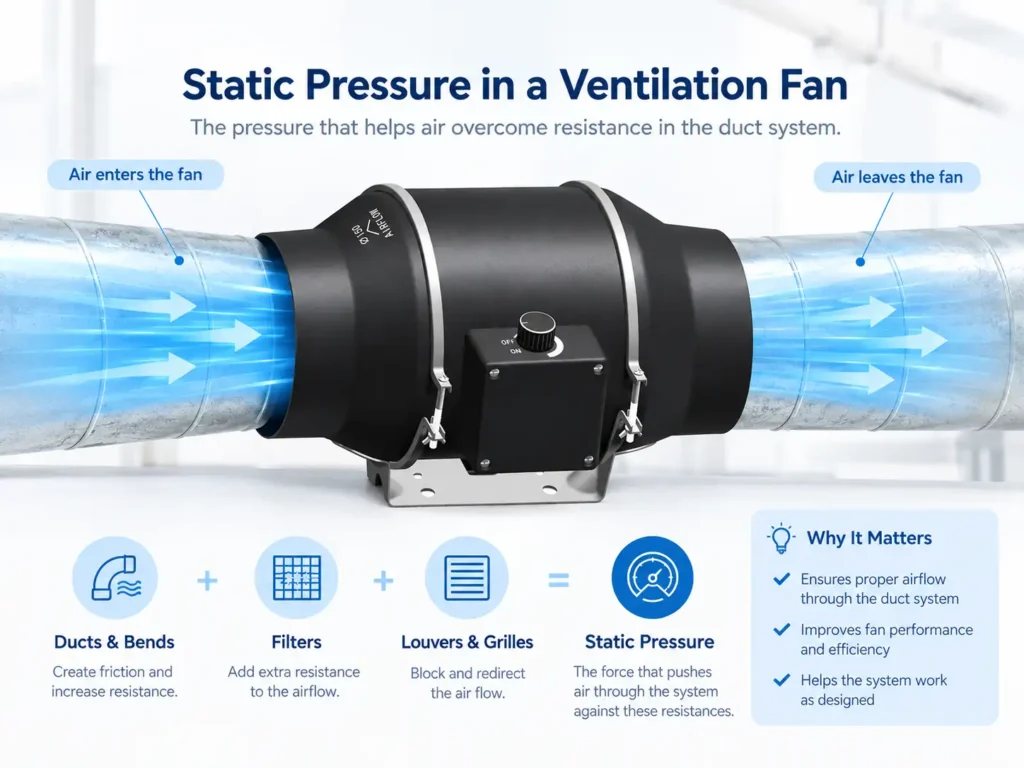
Once a fan is connected to a duct system, air has to overcome resistance from ducts, bends, filters, grilles, and other components. This resistance is related to static pressure.
Understanding static pressure can help you select a ventilation fan that delivers the airflow you actually need.
What Is Static Pressure?
Static pressure is the resistance that a ventilation fan needs to overcome while moving air through a system.
It is commonly measured in Pa (Pascal).
In a simple installation with a short, straight duct, air resistance may be relatively low. But when the system includes long ducts, multiple bends, filters, dampers, or other restrictions, the resistance increases.
As resistance increases, the actual airflow from the fan can decrease.
A simple way to understand the relationship is:
Higher system resistance → Lower actual airflow
This is why looking at the fan’s maximum airflow alone may not be enough when selecting a ventilation fan.
What Causes Static Pressure in a Ventilation System?
Several components can create resistance in an air ventilation system.
1. Long Ducts
The longer the duct, the more resistance the air encounters.
For example, a fan installed directly through a wall may have relatively little resistance, while a fan connected to a long duct system may need to overcome considerably more resistance.
2. Duct Bends
Every bend changes the direction of airflow.
Multiple bends can increase resistance, especially when the duct system is not designed efficiently.
3. Filters
Filters are useful for removing dust and particles from the air, but they also create resistance.
As a filter becomes dirty, its resistance can increase further.
4. Grilles and Dampers
Air grilles, dampers, louvers, and other components can also restrict airflow.
This is particularly important when designing a complete ventilation system rather than selecting a fan by itself.
5. Incorrect Duct Size
A duct that is too small for the required airflow can increase air velocity and system resistance.
The duct size should therefore be considered together with the fan airflow requirement.
Static Pressure vs. Airflow
Airflow and static pressure are closely related, but they describe different things.
Airflow tells you how much air the fan can move.
Static pressure indicates how much resistance the fan can overcome.
For example, a fan may have a rated airflow of 500 CFM under a specific test condition. Once connected to a duct system, the actual airflow may be lower because the system creates resistance.
This is why professional fan selection often considers both airflow and static pressure.
Why Is Static Pressure Important for Inline Duct Fans?
Static pressure is especially important for inline duct fans because these fans are normally connected to ductwork.
A typical inline duct fan system may include:
Fan → Duct → Bend → Filter → Grille → Exhaust Outlet
Each component can contribute to system resistance.
For this reason, the fan should be selected according to the required airflow at the expected system resistance rather than simply choosing the model with the highest advertised CFM.
How to Read a Fan Performance Curve
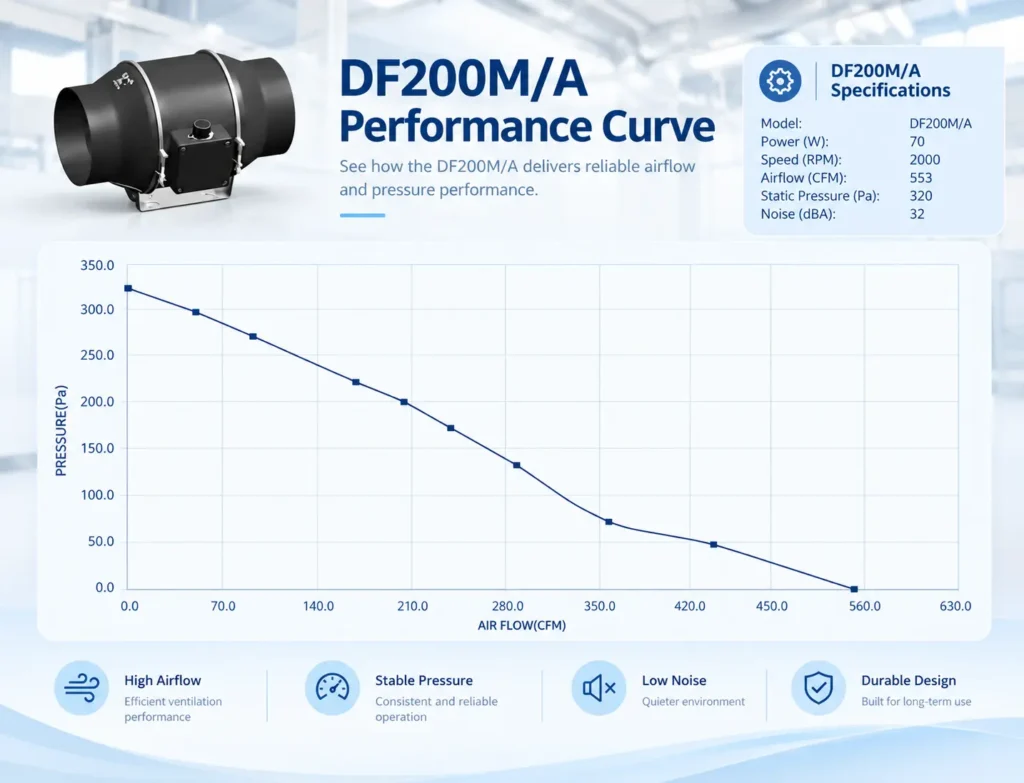
A fan performance curve shows the relationship between airflow and static pressure.
Generally, when static pressure increases, the available airflow decreases.
For example, a fan may provide a high airflow when there is little resistance. When the system resistance increases, the operating point moves along the performance curve and the actual airflow becomes lower.
This is why a performance curve is more useful than looking at a single maximum airflow number.
How to Reduce Static Pressure in a Ventilation System
If a ventilation system has excessive resistance, several improvements can help:
- Use the appropriate duct diameter
- Keep duct runs as short as practical
- Reduce unnecessary bends
- Use smooth and properly connected ducts
- Keep filters clean
- Avoid unnecessary restrictions at the exhaust outlet
- Select a fan with sufficient static pressure capability
Good system design can improve airflow without simply increasing fan power.
How Much Static Pressure Does a Fan Need?
There is no single static pressure value that is suitable for every ventilation system.
The required pressure depends on the complete system, including:
- Required airflow
- Duct length
- Duct diameter
- Number of bends
- Filters
- Grilles
- Dampers
- Exhaust outlets
For example, our EC inline duct fan range includes models with different airflow and static pressure characteristics:
| Model | Airflow | Static Pressure | Power |
|---|---|---|---|
| DF100-M | 205 CFM | 245 Pa | 25 W |
| DF150-M | 350 CFM | 360 Pa | 50 W |
| DF200-M | 553 CFM | 320 Pa | 70 W |
These specifications should be evaluated together with the actual duct system and required operating point.
Conclusion
Static pressure is an important factor in ventilation fan selection.
While CFM tells you how much air a fan can move, static pressure helps explain how the fan performs when it encounters resistance from ducts, filters, bends, grilles, and other components.
For a simple exhaust installation, static pressure may not be a major concern. For ducted ventilation systems, however, it can have a significant effect on actual airflow.
When selecting an inline duct fan, consider airflow, static pressure, duct design, and the complete ventilation system together.
For more information about our EC inline duct fans and performance curves, contact our team with your required airflow and application details.