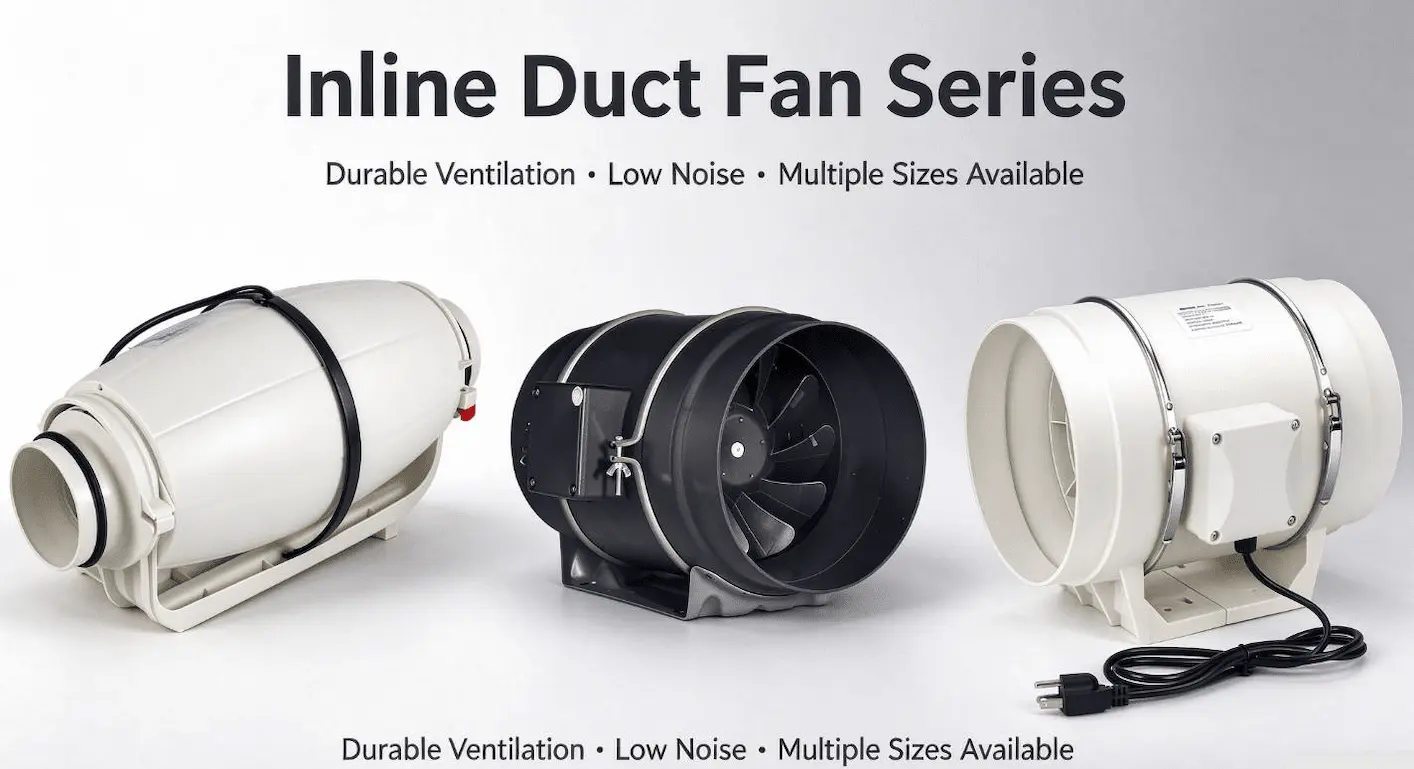
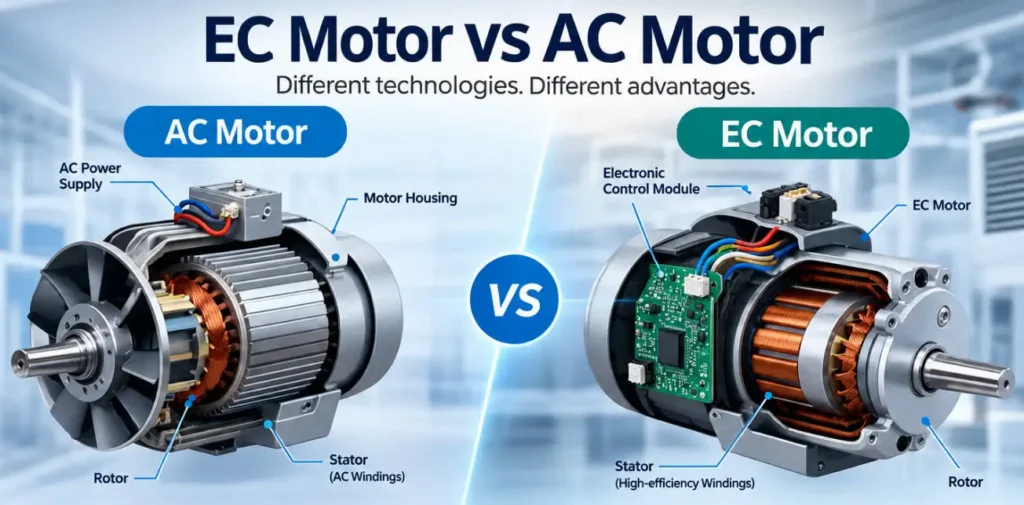
Two common motor technologies used in ventilation equipment are AC motors and EC motors. Although both can be used to drive fans, they work differently and have different characteristics in terms of efficiency, speed control, noise, and operating cost.
So, what is the difference between an EC motor and an AC motor?
What Is an AC Motor?
An AC motor is powered directly by alternating current (AC).
AC motors have been widely used in ventilation fans, exhaust fans, blowers, and other equipment for many years. They are available in different designs, including shaded-pole motors, capacitor motors, and other induction-based motor types.
A basic AC fan system can be understood as:
AC Power → AC Motor → Fan Blade → Airflow
The motor converts electrical energy into mechanical rotation, which drives the fan to move air.
AC motors are popular because they are relatively simple, widely available, and suitable for many conventional ventilation applications.
What Is an EC Motor?
EC stands for Electronically Commutated.
An EC motor uses electronic control technology to manage the motor’s operation. Unlike a conventional AC motor, an EC motor typically combines a motor with built-in electronic commutation and control.
A simplified system looks like:
Power → Electronic Control → EC Motor → Fan → Airflow
The electronics control how the motor operates and can provide more precise speed control.
EC motors can also be designed to accept different power inputs depending on the motor and control system.
EC Motor vs. AC Motor: Key Differences
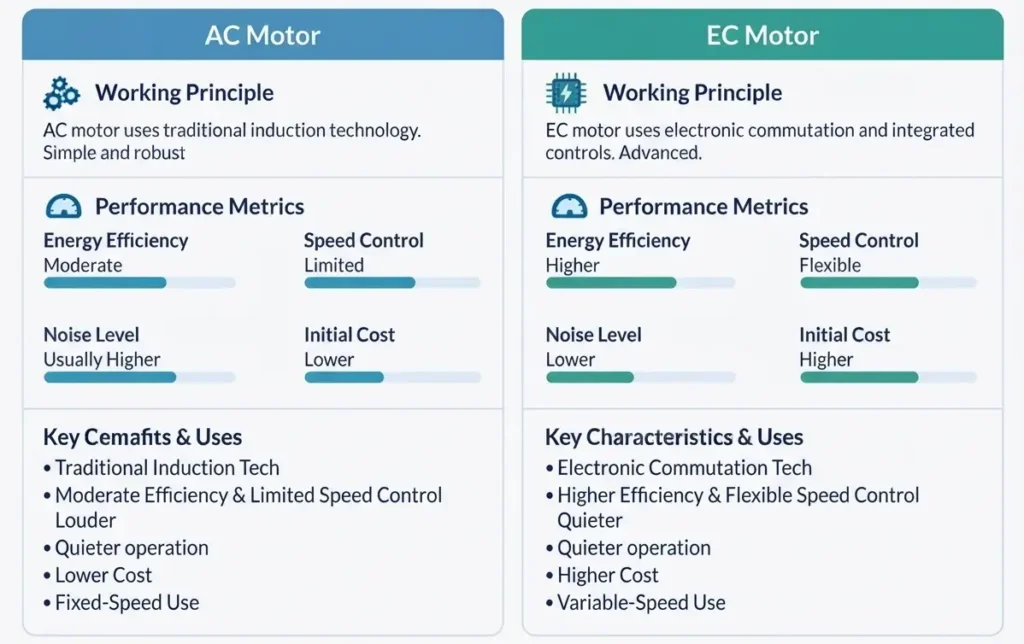
The actual performance depends on the specific motor and fan design, so these differences should be treated as general characteristics rather than absolute rules.
1. Energy Efficiency
One of the main reasons EC motors are increasingly used in ventilation equipment is their efficiency.
A conventional AC motor may continue operating at a fixed speed even when the application does not require maximum airflow.
An EC motor can be controlled to operate at an appropriate speed for the required airflow.
For systems that operate for long periods or require frequent speed adjustment, this can provide an opportunity to reduce energy consumption.
However, energy savings depend on the actual operating conditions, control strategy, and motor design.
2. Speed Control
Speed control is another major difference.
Traditional AC fans can use methods such as voltage control or frequency control, depending on the motor type and application.
EC motors are designed with electronic control, making variable-speed operation easier to implement.
For example, a ventilation system may not need maximum airflow all the time. The fan can operate at a lower speed when ventilation demand is low and increase speed when more airflow is required.
This makes EC motors particularly useful for applications where airflow needs to change according to operating conditions.
3. Noise
Motor technology can also affect fan noise.
Because EC motors can operate efficiently at different speeds, they can be used in systems where lower operating speeds are desirable.
However, motor noise is only one part of total fan noise.
The impeller design, airflow velocity, ductwork, vibration, installation, and operating point can all affect the final noise level.
Therefore, an EC motor does not automatically mean that a fan will always be quieter than an AC fan.
4. Initial Cost
AC motors are generally more economical to manufacture and are widely available.
EC motors include additional electronic components, so their initial purchase price is often higher.
However, initial purchase price is only one part of the total cost.
For equipment that operates for many hours, factors such as energy consumption, speed control, maintenance, and operating requirements should also be considered.
5. Where Are AC Motors Commonly Used?
AC motors remain a practical choice for many ventilation applications.
Typical applications include:
- Bathroom exhaust fans
- General exhaust fans
- Wall-mounted ventilation fans
- Basic air circulation systems
- Applications with relatively constant airflow requirements
If the fan mainly operates at one speed and the system has straightforward ventilation requirements, an AC motor can be a suitable solution.
6. Where Are EC Motors Commonly Used?
EC motors are particularly useful when efficiency and variable-speed control are important.
Common applications include:
- Inline duct fans
- HVAC systems
- Commercial ventilation
- Greenhouse ventilation
- Energy-conscious building systems
- Applications requiring variable airflow
They are also useful when the ventilation system needs to adjust airflow according to different operating conditions.
Which Motor Should You Choose?
There is no universal answer that one motor type is better for every application.
Consider an AC motor when:
- Initial cost is a major consideration
- The fan mainly operates at a fixed speed
- Variable-speed control is not required
- The ventilation system is relatively simple
Consider an EC motor when:
- Energy efficiency is important
- Variable airflow is required
- The fan operates for long periods
- Precise speed control is useful
- The ventilation system has changing airflow requirements
The best choice depends on the complete application rather than the motor type alone.
Conclusion
Both AC and EC motors have important roles in ventilation equipment.
AC motors are widely used because of their simple design, established technology, and relatively low initial cost.
EC motors use electronic commutation and offer advantages in efficiency and speed control, making them increasingly common in modern ventilation systems.
When choosing a ventilation fan, don’t look at the motor alone. Consider airflow, static pressure, operating hours, speed control, noise, installation conditions, and total operating cost.
Understanding the difference between AC and EC motors can help you select a ventilation fan that better matches the requirements of your application.