
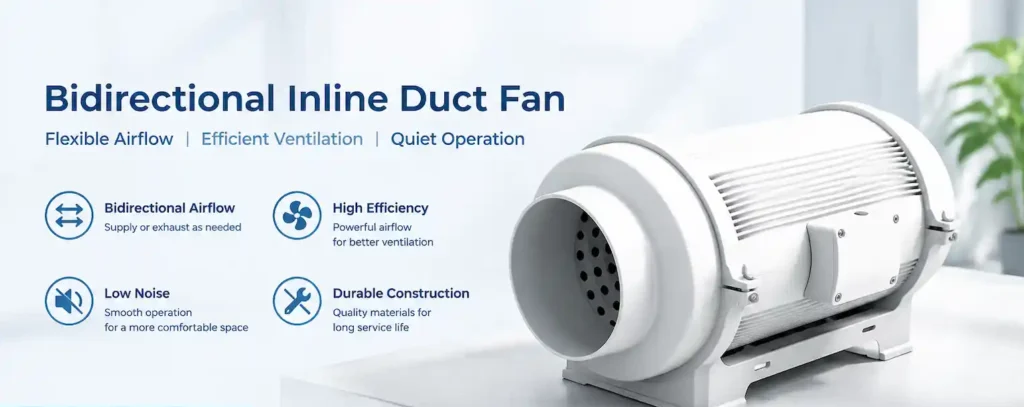
What Is a Bidirectional Inline Duct Fan?
A bidirectional inline duct fan is a duct-mounted ventilation device designed for applications that require airflow in different directions. Installed directly within a duct system, it provides a compact solution for moving air without requiring a conventional wall-mounted or ceiling-mounted fan.
Unlike standalone ventilation fans, inline duct fans integrate into the ductwork, making them suitable for residential, commercial, and light-duty ventilation projects where equipment space and duct layout matter.
When selecting a bidirectional fan, it is important to confirm how the specific model changes airflow direction, including its motor design, control method, and installation requirements.
How Does a Bidirectional Inline Duct Fan Work?
The fan uses a motor-driven impeller to move air through connected ductwork. Depending on the model’s design and control configuration, airflow can be directed to support different ventilation requirements.
In a suitable system, this flexibility can help support air supply, exhaust, or changing ventilation needs. The duct layout, external resistance, and operating controls all affect actual performance.
For reliable operation, the fan should be matched to the duct diameter and required airflow. Proper duct connections and a well-planned installation also help reduce unnecessary resistance and noise.
Key Applications
Residential Ventilation
Inline duct fans can be integrated into ventilation layouts for apartments, houses, bathrooms, and other spaces that need controlled air movement. The appropriate configuration depends on the room, duct route, and ventilation requirements.
Commercial Ventilation
Offices, small commercial premises, and service areas may use inline fans to move air through concealed ductwork. Their in-duct installation helps keep the main fan unit out of direct view.
Grow Rooms and Indoor Cultivation
Indoor growing environments often require planned air exchange to help manage heat, humidity, and air circulation. A correctly sized inline fan can form part of the ventilation system, subject to the required airflow and environmental conditions.
Flexible Airflow Management
Where a ventilation system needs different operating modes, a bidirectional design may offer additional flexibility. Before specifying the equipment, confirm that the model supports the required direction-changing function and control method.
TF Series Bidirectional Inline Duct Fans
Our TF series offers four duct-size options to suit different ventilation requirements, from compact installations to systems requiring higher airflow.
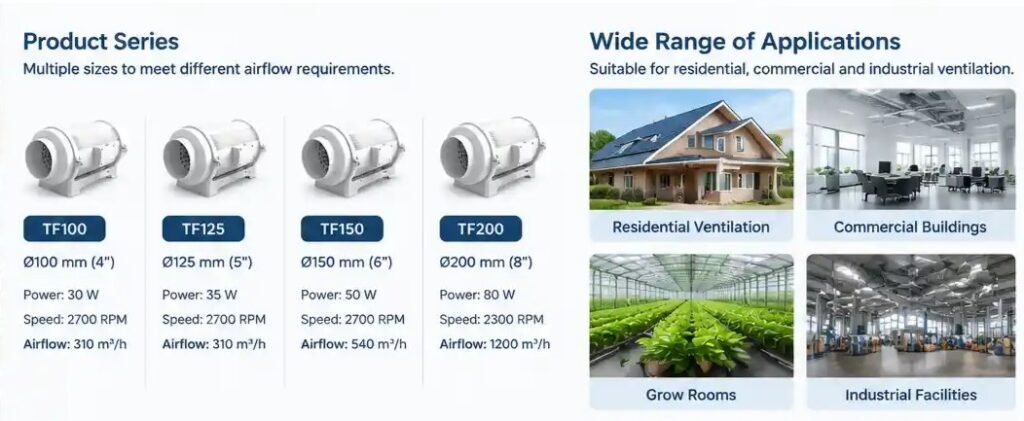
The listed electrical specifications are 110–240 V, 50 Hz for TF100, TF125, and TF150, and 220 V, 50 Hz for TF200. Confirm the required supply voltage before ordering.
How to Choose the Right Model
TF100 — 4-inch: A compact option for smaller duct systems where the required airflow is within the model’s capacity.
TF125 — 5-inch: Suitable for projects requiring a 125 mm duct connection. Its listed airflow is 310 m³/h.
TF150 — 6-inch: Provides a listed airflow of 540 m³/h for applications requiring greater air movement.
TF200 — 8-inch: Offers the highest listed airflow in this series, at 1200 m³/h, for systems with greater ventilation demand.
These airflow figures are product specifications, not guaranteed airflow under every installation condition. Actual performance depends on system resistance, duct design, and operating conditions.
What Should You Consider Before Installation?
Before selecting a bidirectional inline duct fan, consider the following:
- Airflow requirements: Estimate the ventilation demand of the space and select a suitable model.
- Duct diameter: Match the fan connections to the ductwork to avoid unnecessary restrictions.
- System resistance: Account for duct length, bends, filters, dampers, and other components that may affect airflow.
- Control compatibility: Confirm the required direction-changing function and compatible controls with the manufacturer.
- Installation and maintenance: Provide secure mounting, sealed duct connections, suitable electrical installation, and access for inspection.
A fan’s maximum listed airflow alone is not enough to determine whether it will meet a project’s needs. The complete duct system must be considered.
Conclusion
A bidirectional inline duct fan can be a practical option for ventilation projects that need flexible airflow management and a compact in-duct installation. The TF series covers 100 mm to 200 mm duct sizes, with listed airflow ranging from 310 m³/h to 1200 m³/h.
Choosing the right model starts with the required airflow, duct dimensions, system resistance, and control requirements. For project-specific selection, confirm the operating modes and performance conditions with the manufacturer before installation.